
I’m going to try to ease you into this one.

A terminal sequence can look like the picture above.
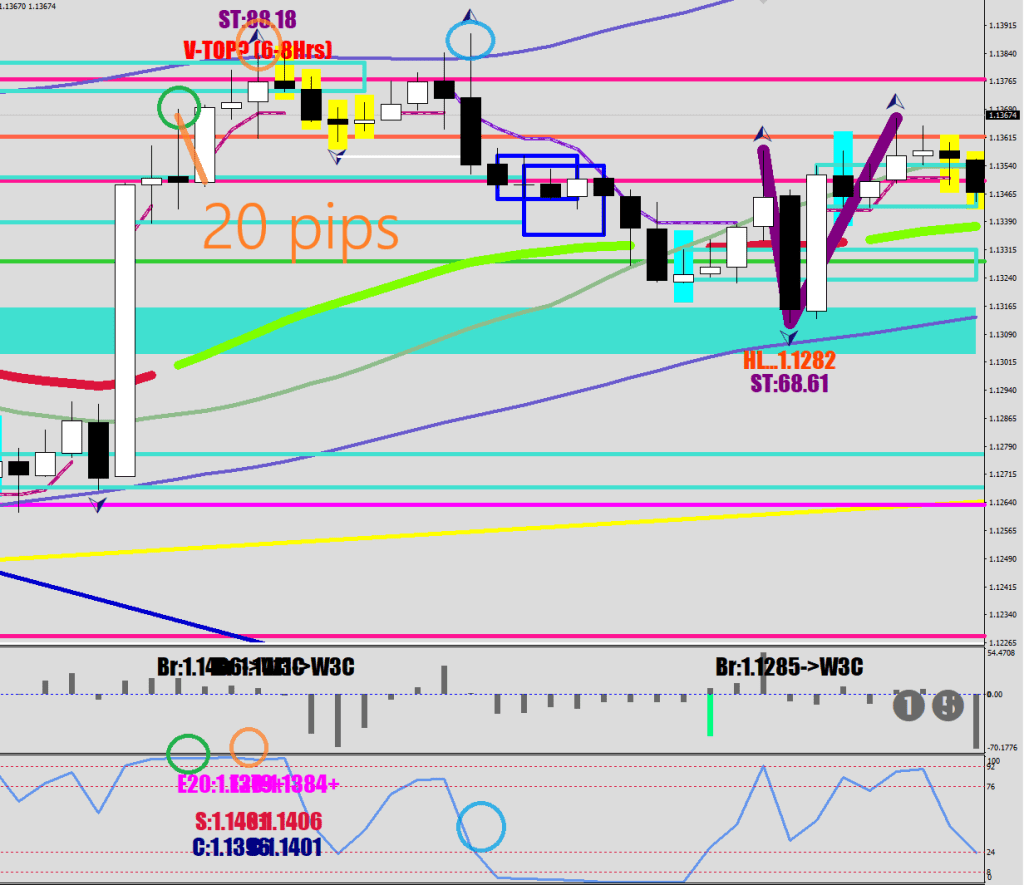
The green circle is the Escrow high, with the RSI2 printing in the last 3%.
The following, Adjustment high (orange) is expected to stay within 20 pips, and would see a pullback prior at a minimum 17 pips, but often 37, and can be as much as seventy-something.
The coda to the sequence is the Thrust. In the picture above, the move did not qualify to be called a Thrust based on my filters (46 pips within 4 hours), but it was an echo move nonetheless.
///Thrust up
High[i]-Low[i+1]>460*Point || High[i]-Low[i+2]>460*Point || High[i]-Low[i+3]>460*Point || High[i]-Low[i+4]>460*Point
2 more examples to start to get the hang of it
Escrow, adjustment, echo
That black doji I sometimes refer to as clutch, particularly if it is preceded by 3 candles of the opposite color.
The following sequence did come with a Thrust, and after the adjustment low the pullback was 35 pips.
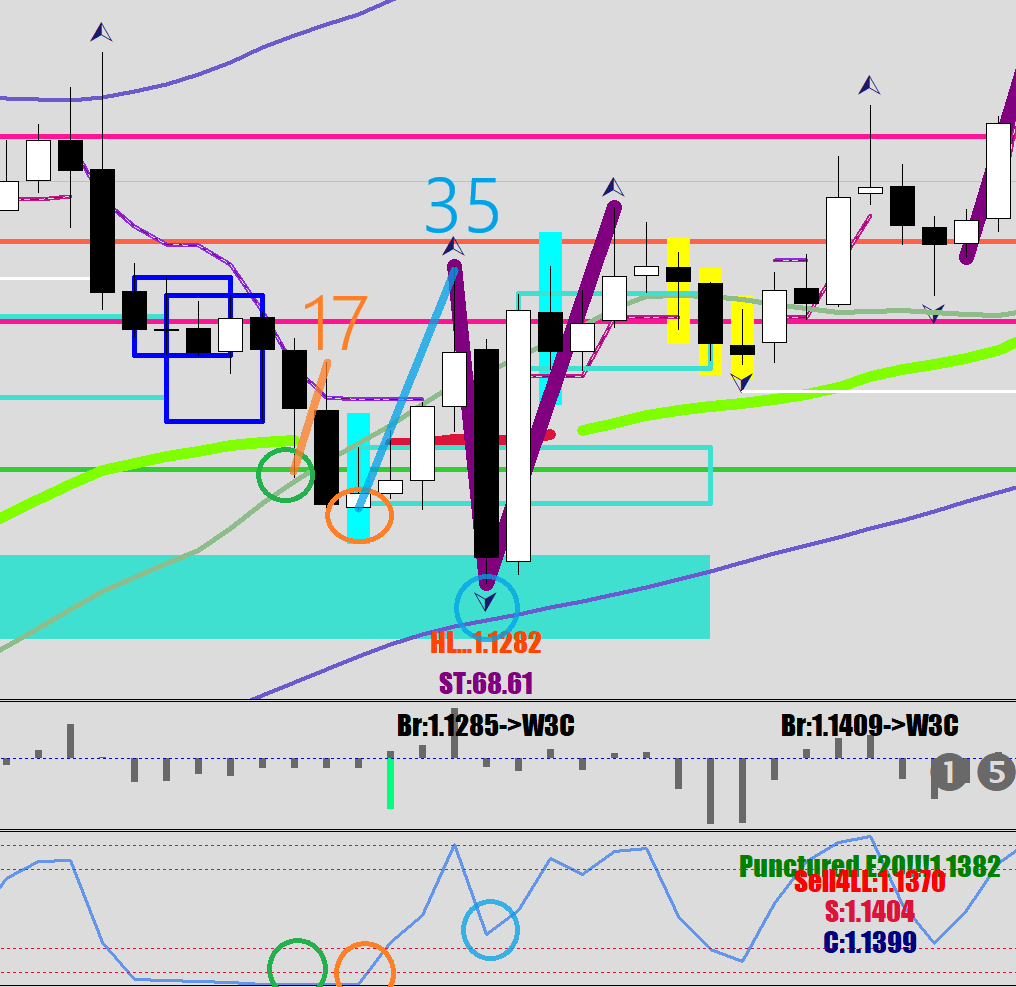
This brings us up to real time. We have seen the Escrow, the Adjustment, and now the 3rd fractal is printing.

Album #71. Hitting 1100 songs soon on the Topic alone.
///V-top
 if (iFractals(symbol,0,MODE_UPPER,i) && High[i]>iBands(symbol,0,30,2,0,PRICE_MEDIAN,MODE_UPPER,i)-100*Point && High[i]>iLow(symbol,0,iLowest(symbol,0,MODE_LOW,11,i))+720*Point && RSI2[i]>96)

in English, the high would have to be at most 10 pips below the upper 30 sample BB, the high would have to be 72 pips higher than the 11-sample low, and the RSI2 reading was already discussed ForexFore - Internals, indicators, algorithmic trading