
The main difference between an open top/bottom and a closed one is the thrust distance from the 6-hour low/high exceeding 84 pips. Those are the green and the red lines.

Open means that one or more higher highs / lower lows are of high likelihood.
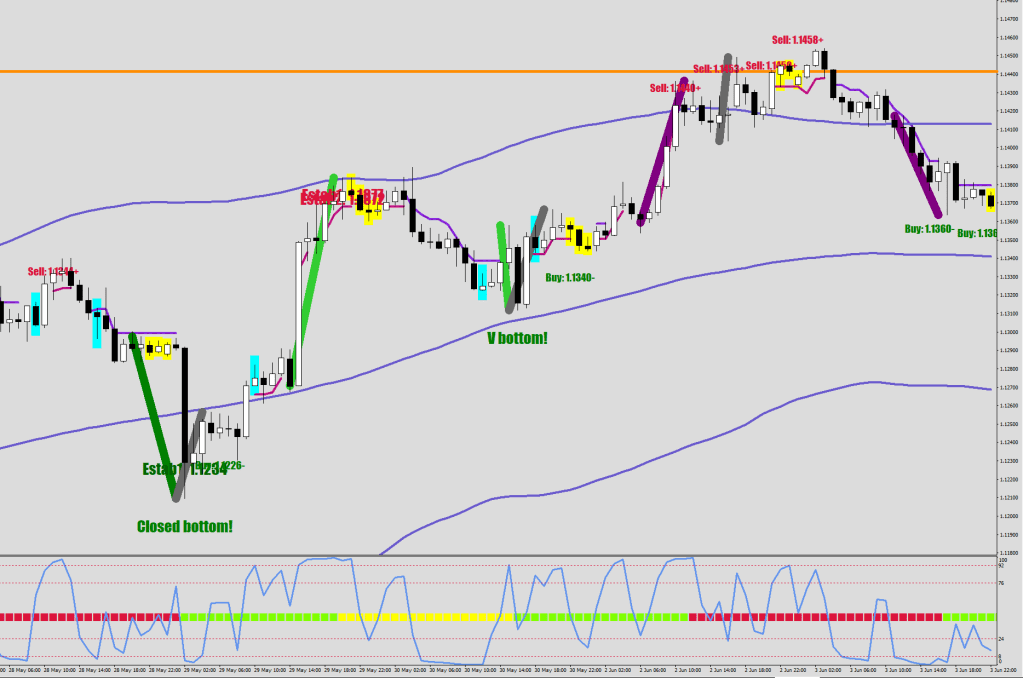
If it does not say closed, it is open.
Now, a bit about the house where it all happens.

The house must be upright, meaning the 12-sample low plus 46 pips has to be above the 12-sample high minus 46 pips. In other instances, I dim the line.
ExtUpperBuffer[i]=iLow(symbol,0,iLowest(symbol,0,MODE_LOW,12,i))+460*Point;
       ExtLowerBuffer[i]=iHigh(symbol,0,iHighest(symbol,0,MODE_HIGH,12,i))-460*Point;
F is a failure at or just outside the front or the back door.
32 is the 32 EMA. This is where they would step up with aggression to try for a slam dunk.
The Trap was a move that was a second time out and fell shy of the 84-pip line.
The goal is to score beyond the yellow line (see the very first image), which I call the max effort zone. It is 84 pips from the 10-sample low/high with a 6-hour delay.
ExtUpperBuffer3[i]=iLow(symbol,0,iLowest(symbol,0,MODE_LOW,10,i+6))+820*Point;
       ExtLowerBuffer3[i]=iHigh(symbol,0,iHighest(symbol,0,MODE_HIGH,10,i+6))-820*Point;
A score is a non-habet, the move lives. The return to the front/back door is a buy.
The second out is what I was trying to bring to your attention.
I shaded the current house pink.

Whenever the price goes outside the house for the second time, you do not want to fade the move until the next thrust is printed.
Those tender moments.
The sound of MU is out.
My Depeche Mode / Dave Gahan style works (30).
 ForexFore - Internals, indicators, algorithmic trading