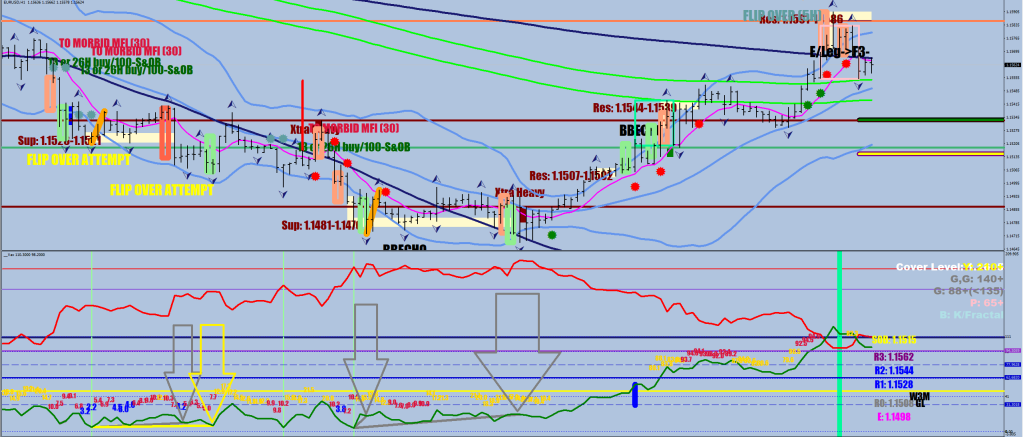
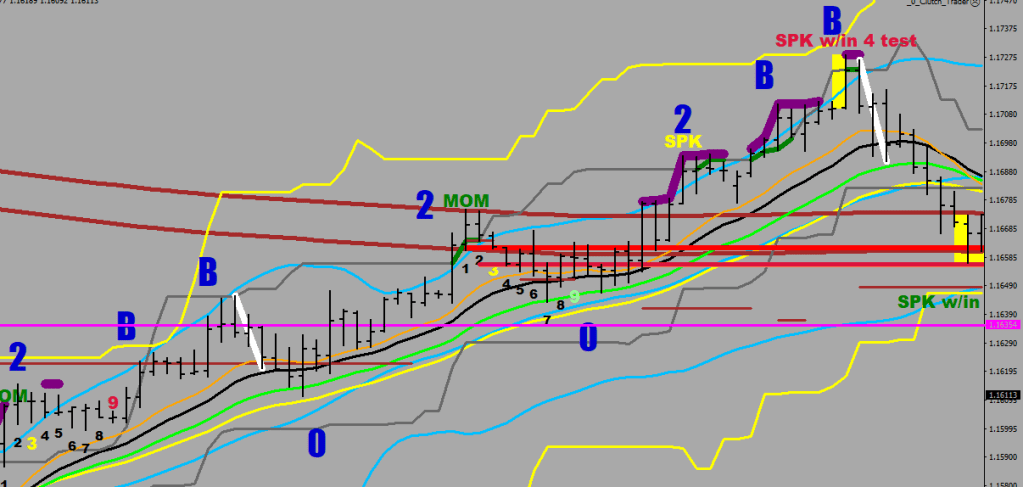
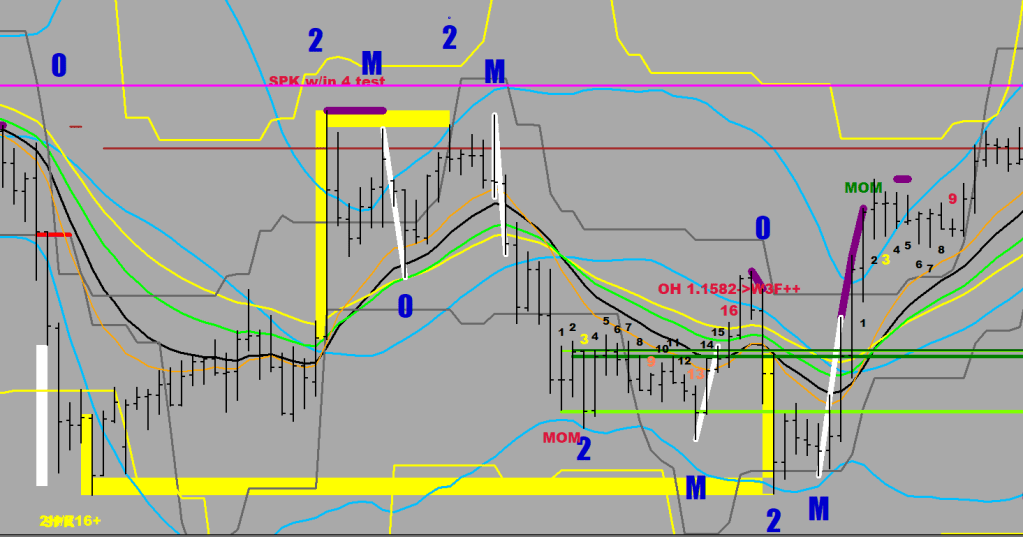
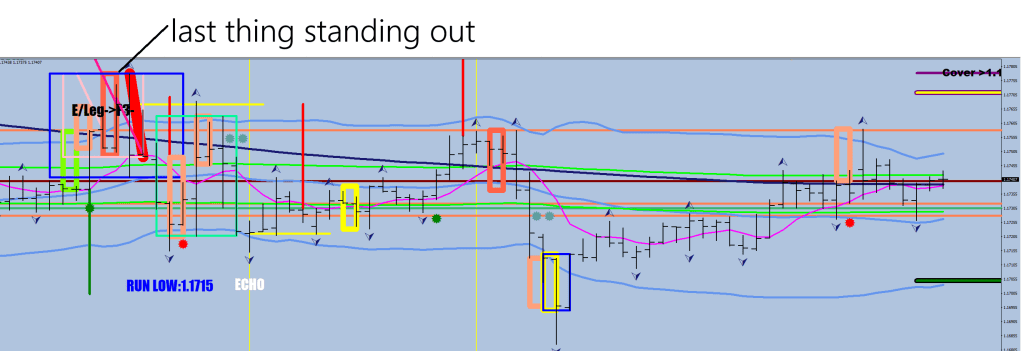
2-M-0-2-M

The next step after plotting the strength of a leg is recognising a reversal pattern.

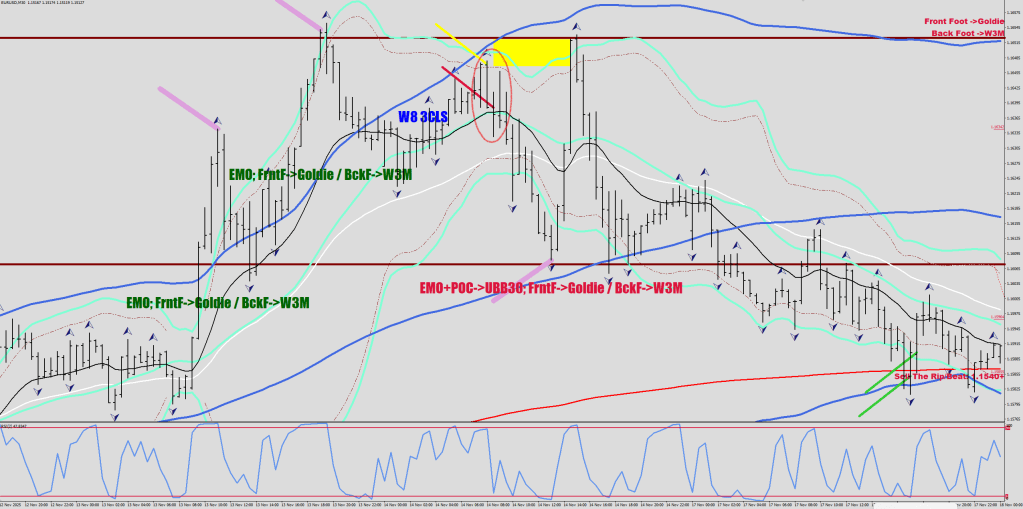
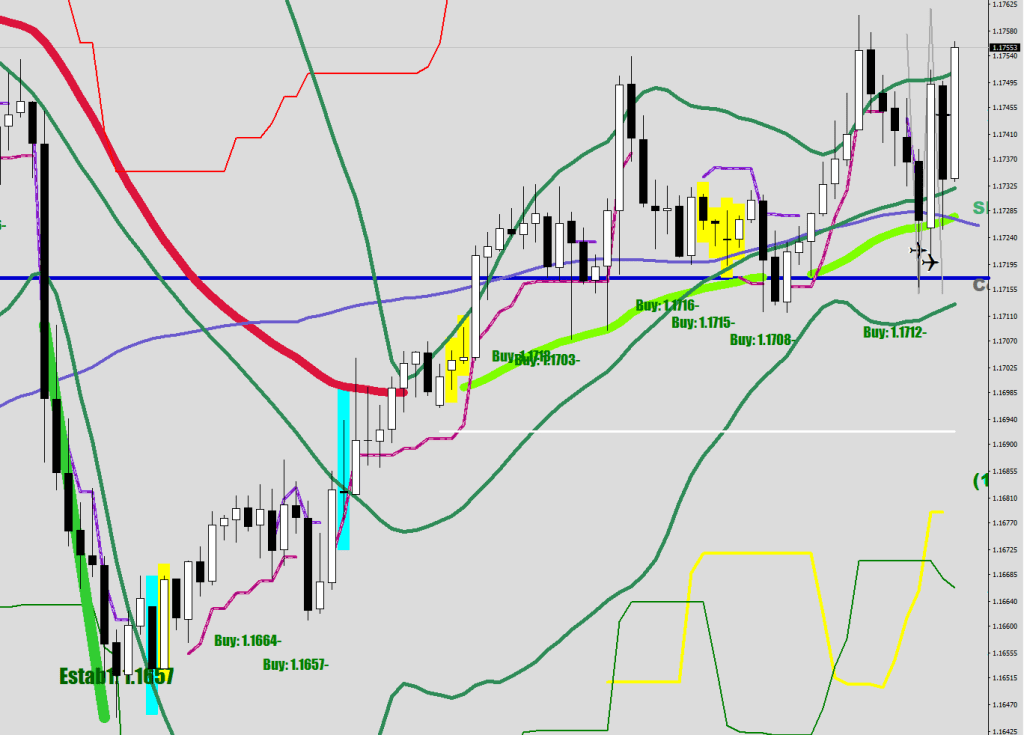
2 means that the leg has made it beyond the dark gray line, but not the thin yellow.

M is a back test (short for Match), it can fall short or beat, but typically by not more than 6 pips.

0 is now clarified as a comeback inside the orange line (12 EMA on the hourly).

The white plots accordingly, are tie-offs. Apparently, you want to see 2 of these as a common denominator.
Channel[i]=(iMA(symbol,0,8,0,MODE_EMA,PRICE_MEDIAN,i)+iMA(symbol,0,16,0,MODE_EMA,PRICE_MEDIAN,i))/2;


////M-tie off Downside
if (iLow(symbol,0,iLowest(symbol,0,MODE_LOW,3,i))==iLow(symbol,0,iLowest(symbol,0,MODE_LOW,5,i)) && Close[i]>Channel[i] && Close[i+1]<Channel[i+1] && High[i+2]<Channel[i+2] && High[i+3]<Channel[i+3]){
ObjectCreate( “Banalist”+IntegerToString(i), OBJ_TREND, 0, Time[iLowest(symbol,0,MODE_LOW,3,i)], iLow(symbol,0,iLowest(symbol,0,MODE_LOW,3,i)) , Time[i], High[i]);
ObjectSet(“Banalist”+IntegerToString(i), OBJPROP_COLOR, clrWhite);
ObjectSet(“Banalist”+IntegerToString(i), OBJPROP_WIDTH, 8 );
ObjectSet(“Banalist”+IntegerToString(i), OBJPROP_RAY_RIGHT, false );
ObjectSet(“Banalist”+IntegerToString(i), OBJPROP_STYLE, 0 );
}


////M-tie off Upside
if (iHigh(symbol,0,iHighest(symbol,0,MODE_HIGH,3,i))>=iHigh(symbol,0,iHighest(symbol,0,MODE_HIGH,5,i))-20*Point && Low[i]<Channel[i] && Close[i]<Channel[i]+40*Point && Close[i+1]>Channel[i+1] && Low[i+2]>Channel[i+2] && Low[i+3]>Channel[i+3]){
ObjectCreate( “Banalist”+IntegerToString(i), OBJ_TREND, 0, Time[iHighest(symbol,0,MODE_HIGH,3,i)], iHigh(symbol,0,iHighest(symbol,0,MODE_HIGH,3,i)) , Time[i], Low[i]);
ObjectSet(“Banalist”+IntegerToString(i), OBJPROP_COLOR, clrWhite);
ObjectSet(“Banalist”+IntegerToString(i), OBJPROP_WIDTH, 8 );
ObjectSet(“Banalist”+IntegerToString(i), OBJPROP_RAY_RIGHT, false );
ObjectSet(“Banalist”+IntegerToString(i), OBJPROP_STYLE, 0 );
}

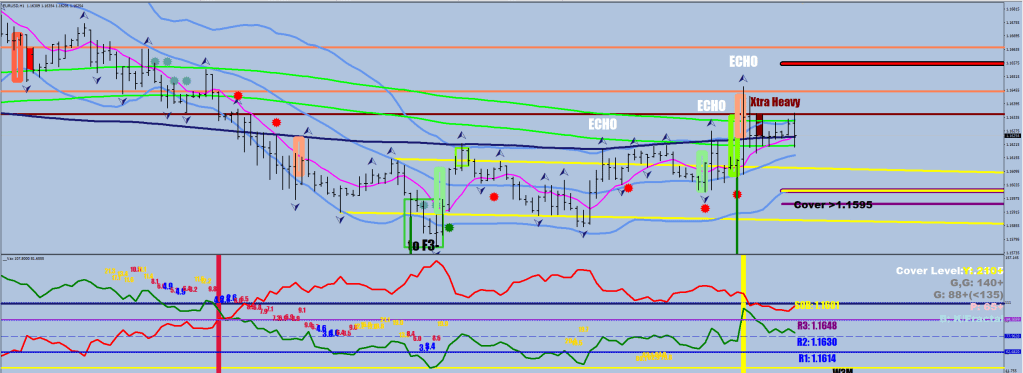
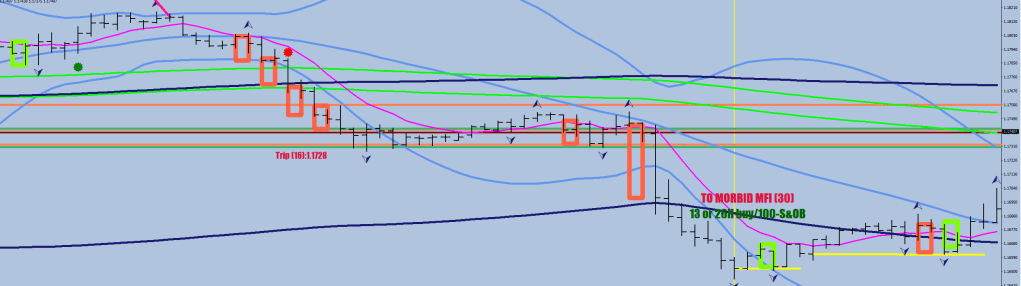
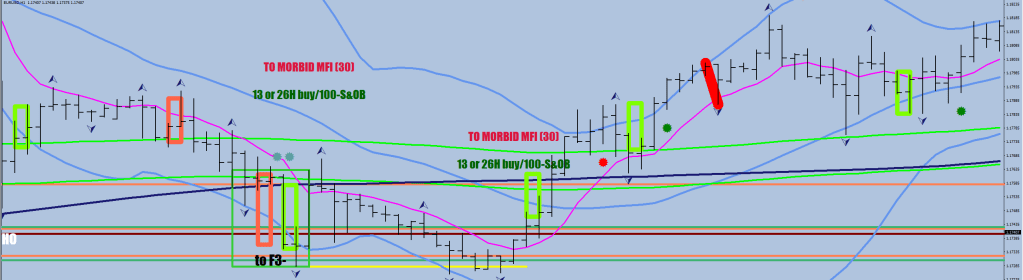
Before proceeding, see how you could have fared with this trending move by going long after the first green box print and closing after the first orange one.

140 pips, not bad.

Now, the 30-minute filters would be a bit different. The 44-EMA is the choice here.

It may not pick the same exact places every time, but the rule of thumb is still to have 2.

Channel[i]=iMA(symbol,0,44,0,MODE_EMA,PRICE_MEDIAN,i);

 ////44-tie off Downside     
  if (
  iLow(symbol,0,iLowest(symbol,0,MODE_LOW,8,i))<=iLow(symbol,0,iLowest(symbol,0,MODE_LOW,10,i)) && 
  Close[i]>Channel[i] && Close[i+1]<Channel[i+1] && Close[i+2]<Channel[i+2]  && Close[i+3]<Channel[i+3] && Close[i+4]<Channel[i+4] && Close[i+5]<Channel[i+5]){  
         ObjectCreate( "Canalist"+IntegerToString(i), OBJ_TREND, 0,  Time[iLowest(symbol,0,MODE_LOW,8,i)], iLow(symbol,0,iLowest(symbol,0,MODE_LOW,8,i)) , Time[i], High[i]);
           ObjectSet("Canalist"+IntegerToString(i), OBJPROP_COLOR, clrLime);
           ObjectSet("Canalist"+IntegerToString(i), OBJPROP_WIDTH, 18 );
           ObjectSet("Canalist"+IntegerToString(i), OBJPROP_RAY_RIGHT, false );
           ObjectSet("Canalist"+IntegerToString(i), OBJPROP_STYLE, 0 ); 
  }


  ////44-tie off Upside     
  if (
   iHigh(symbol,0,iHighest(symbol,0,MODE_HIGH,6,i))>=iHigh(symbol,0,iHighest(symbol,0,MODE_HIGH,8,i))-20*Point && 
  Close[i]<Channel[i] && Close[i+1]>Channel[i+1] && Close[i+2]>Channel[i+2]  && Close[i+3]>Channel[i+3] && Close[i+4]>Channel[i+4] && Close[i+5]>Channel[i+5]){  
         ObjectCreate( "Canalist"+IntegerToString(i), OBJ_TREND, 0,  Time[iHighest(symbol,0,MODE_HIGH,6,i)], iHigh(symbol,0,iHighest(symbol,0,MODE_HIGH,6,i)) , Time[i], Low[i]);
           ObjectSet("Canalist"+IntegerToString(i), OBJPROP_COLOR, clrTomato);
           ObjectSet("Canalist"+IntegerToString(i), OBJPROP_WIDTH, 18 );
           ObjectSet("Canalist"+IntegerToString(i), OBJPROP_RAY_RIGHT, false );
           ObjectSet("Canalist"+IntegerToString(i), OBJPROP_STYLE, 0 ); 
  }


Strength Of A Leg

I used to think that out of the 4 charts I was displaying on my two 32-inch monitors, this was the most useless. This changed yesterday.

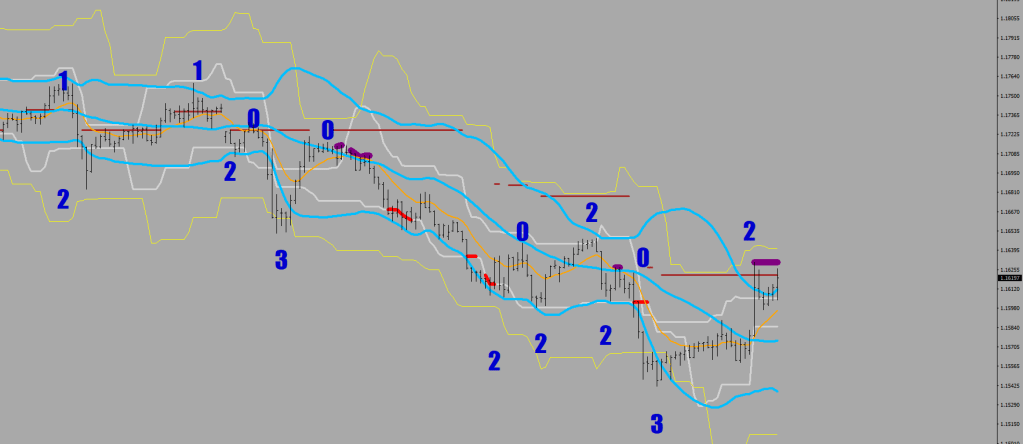
If you score a leg by which line it managed, you will have a 1 at the 30 BB (hourly), 2 at the gray bracket, and 3 at or beyond the yellow bracket. A “0” – S30 is only in play after a 3 print.

This is a million times better than that “strength of a currency” idea that Andy Demi is shilling on YouTube. There used to be a guy on LinkedIn who was posting currency strength comparisons (with very little English, a Serb maybe?) and was scamming people with cell phone screenshots of demo accounts, and every time he commented himself: “Nice!”. Probably had no real money left to play with. I blocked him at some point.

The problem with the stochastic approach for currency futures is that in the deeply overbought/oversold field, a reversal is just as likely as a continuation move (no edge there) as it is the darkest before dawn, and there is also the issue of interventions. Particularly the Yen, which mostly happens overnight. A smaller issue is the which timeframe/sample size.

Now, I haven’t gotten too far yet, but I have found 3 things.

A #1 sell or buy is definitely an at will step in with volume, so pay attention to those prints. If you had a #3 in one direction (a measuring leg), there will likely be a contest/repeat of that distance in the form of another #3 (divergent leg).

After 2, sell a quick 0 (3-5h) for a 2
After a 3, sell a 0 for another 3
join a #1 at will sell at 0 for a move to 2

The gray displacement brackets (46 pips from the 13-sample high/low):

ExtUpperBuffer[i]=iLow(symbol,0,iLowest(symbol,0,MODE_LOW,12,i))+460*Point;
       ExtLowerBuffer[i]=iHigh(symbol,0,iHighest(symbol,0,MODE_HIGH,12,i))-460*Point;

The yellow displacement brackets (82-pips from the 11-sample high/low with a 6-hour delay):

ExtUpperBuffer3[i]=iLow(symbol,0,iLowest(symbol,0,MODE_LOW,10,i+6))+820Point; ExtLowerBuffer3[i]=iHigh(symbol,0,iHighest(symbol,0,MODE_HIGH,10,i+6))-820Point;
      

On Album #89, I concentrated on making AI really sing.

Vol #2 Heureka

So, there are now four colors.

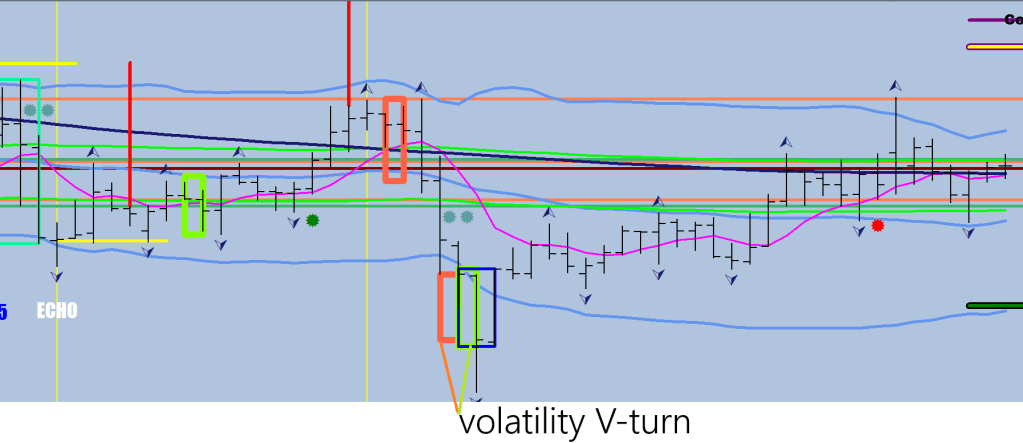
Using 20 pips as still low volatility measure, both red scale is split to an Orange (low vol) and a Tomato (high vol), and the green side has Yellow (low vol) and Chartreuse (high vol).

What is the point of this?

For one, a single low-volatility push may not get things moving strongly in a direction.

All of a sudden it is relatively easy to spot the last large directional box (Ariana) and its retracement (Grande).

I plotted the yellow box on the wrong side of the retracement.

All of which leaves us with a low volatility selling block currently.

The second tomato was fully retraced. Waiting for another high volatility push.


///14.5-pip push up
 if ((Close[i+2]-Low[i+2])<140*Point && (Close[i+1]-Low[i+1])<140*Point && (Close[i]-Low[i])>145*Point && stoch60[i]>stoch60[i+1] ){
          ObjectCreate("Frogo"+IntegerToString(i), OBJ_RECTANGLE, 0,  Time[i+2], Low[i], Time[i+1], Close[i]);
          if ((Close[i]-Low[i])<200*Point) ObjectSetInteger(0,"Frogo"+IntegerToString(i),OBJPROP_COLOR,clrYellow);
          else ObjectSetInteger(0,"Frogo"+IntegerToString(i),OBJPROP_COLOR,clrChartreuse);
          ObjectSet("Frogo"+IntegerToString(i),OBJPROP_BACK,0);
          ObjectSet("Frogo"+IntegerToString(i),OBJPROP_WIDTH,13);
 }
 

 ///14.5-pip push up
 if ((High[i+1]-Close[i+1])<140*Point && (High[i]-Close[i])>145*Point ){
 //&& stoch60[i]<stoch60[i+1]
          ObjectCreate("Frogo"+IntegerToString(i), OBJ_RECTANGLE, 0,  Time[i+2], High[i], Time[i+1], Close[i]);
          if ((High[i]-Close[i])<200*Point) ObjectSetInteger(0,"Frogo"+IntegerToString(i),OBJPROP_COLOR,clrLightSalmon);
          else ObjectSetInteger(0,"Frogo"+IntegerToString(i),OBJPROP_COLOR,clrTomato);
          ObjectSet("Frogo"+IntegerToString(i),OBJPROP_BACK,0);
          ObjectSet("Frogo"+IntegerToString(i),OBJPROP_WIDTH,13);
 }

I just continue to make over-the-top stuff because I don’t know any better.


Also, this guy would not be the first Fraud Shapiro has interviewed.


I have kind of stopped making album videos as it is very time-consuming to collect 800-900 images per 55-65 minutes, and it is not worth the effort. This one may be the last one for a while.


Also, now that we are playing Marco Polo, here are all 26 episodes of the Travels Of The Young M. P.

I worked on 11 episodes as a Compositor (under Cinemon KFT).

Half of the episodes were put together in India.

The Compositing Supervisor was Patrick Menge from MotionWorks in Germany.

Maket Vol

Don’t ask why, but 14.5 pips is where the volatility tips the scale on the Euro (per hour), hence I made a plot for it.

 ///14.5-pip push up
 if ((Close[i+2]-Low[i+2])<140*Point && (Close[i+1]-Low[i+1])<140*Point && (Close[i]-Low[i])>145*Point && stoch60[i]>stoch60[i+1] ){
          ObjectCreate("Frogo"+IntegerToString(i), OBJ_RECTANGLE, 0,  Time[i+2], Low[i], Time[i+1], Close[i]);
          ObjectSetInteger(0,"Frogo"+IntegerToString(i),OBJPROP_COLOR,clrChartreuse);
          ObjectSet("Frogo"+IntegerToString(i),OBJPROP_BACK,0);
          ObjectSet("Frogo"+IntegerToString(i),OBJPROP_WIDTH,11);
 }
 

 ///14.5-pip push up
 if ((High[i+1]-Close[i+1])<140*Point && (High[i]-Close[i])>145*Point && stoch60[i]<stoch60[i+1]){
          ObjectCreate("Frogo"+IntegerToString(i), OBJ_RECTANGLE, 0,  Time[i+2], High[i], Time[i+1], Close[i]);
          ObjectSetInteger(0,"Frogo"+IntegerToString(i),OBJPROP_COLOR,clrTomato);
          ObjectSet("Frogo"+IntegerToString(i),OBJPROP_BACK,0);
          ObjectSet("Frogo"+IntegerToString(i),OBJPROP_WIDTH,11);
 }

I find this very useful, a minimal effort glance can provide you with a volatility V turn information, call attention to a continuation fact, and often give you the are to go long/short.


Udio was acting out and producing 80-90% junk for almost a week.

It always amazes me how different tastes the audience may have on various platforms. It’s either that or YouTube choosing between promoting or not makes or breaks anything.

Stochastic Unravelling

The question always ends up being about priorities.

What beats what then?

What is on the level?

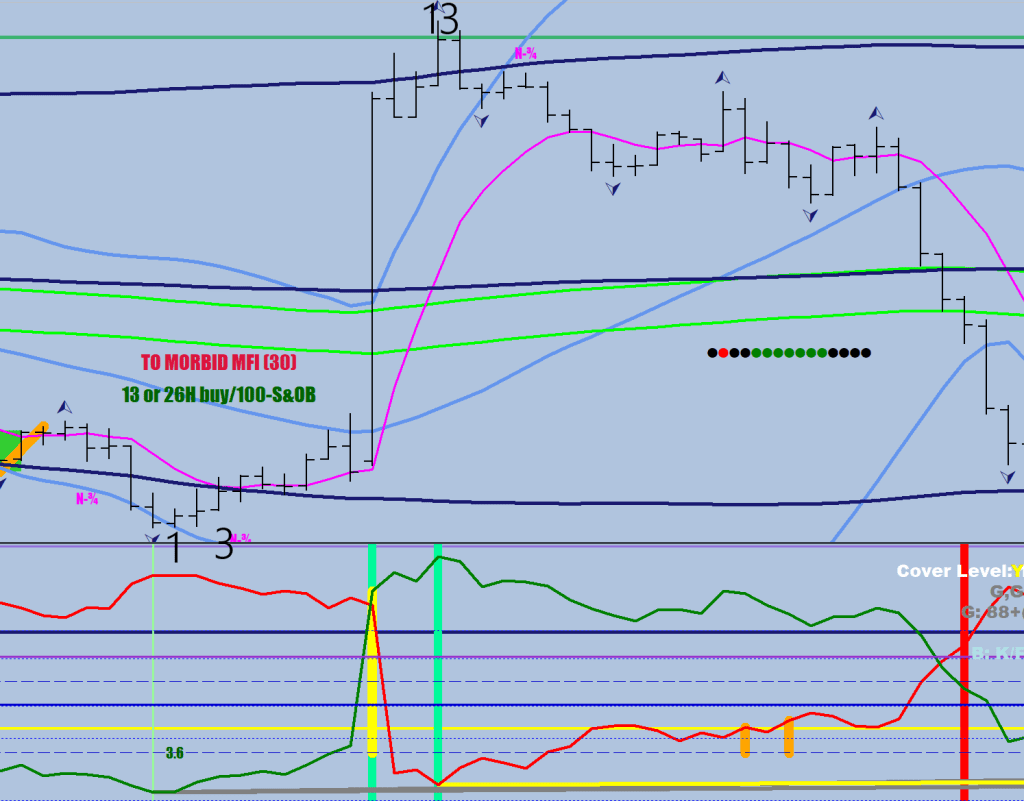
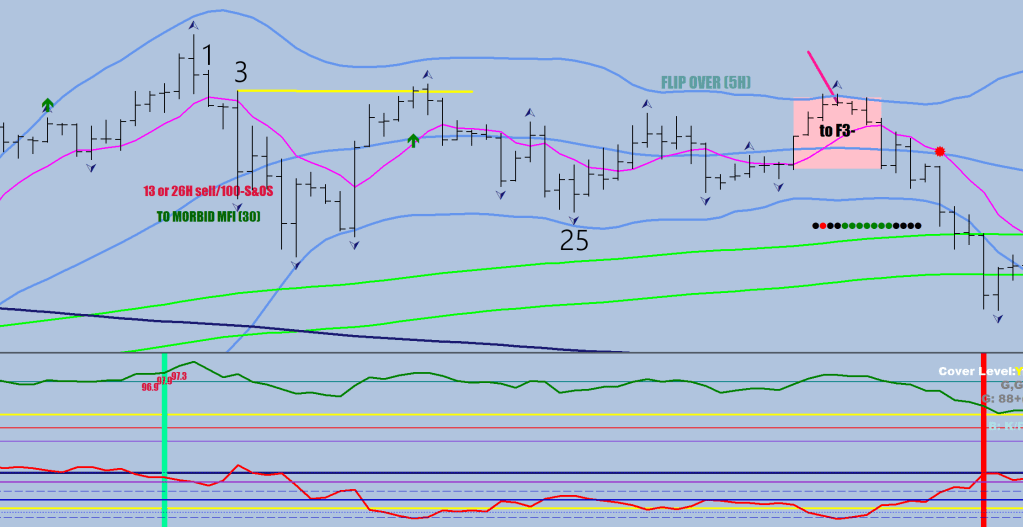
It seems to me that the cornerstone is the severely overbought/oversold condition (60-sample stoch, 1H, last 4%).

Yes, I still have that 8-ball plot somewhere.

step #1

Write the program for the Stochastic unravelling. (Win Robbins Cup).

The severely OB/O  priority trade

(a mean reversion is likely underway upon 1, but certainly 2 gray Vax divergences)

stochastic unravelling to 13/25/momentum divg. 

<4 / >96 hourly disconnect

- from the fractal candle, the 2nd or 3rd hour's close is the entry

if there was directional excess outside the BB

or price rips beyond the 240 BB

dump the holdings on the 13th hour's close

in 13 hours #1 resistance prints after a hourly close outside 

if there was no directional access (overrun) after the numbers

- adjust the trail

- add holdings for 13 more hours at the back test kiss of hour #13

- dump on hour 25's close if it fails to get back outside the BB

- dump on a leg that comes from inside the 8 EMO and closes outside the BB after the 25th hour with the stochastic breaking into the opposite end

- if there was momentum (st. bar) AFTER 2 Fractal Prints on the inside, aim for a high volatility turn with 
an OverHedge to just outside the house (momentum divergence)

step #2

Who the hell is a rebel capitalist?


Preview for Album #88

Promoted Demoted

By calling upon Vax within the 30-minute window with a 398-sample dataset, the Fractal MFI divergence can receive an additional flag.

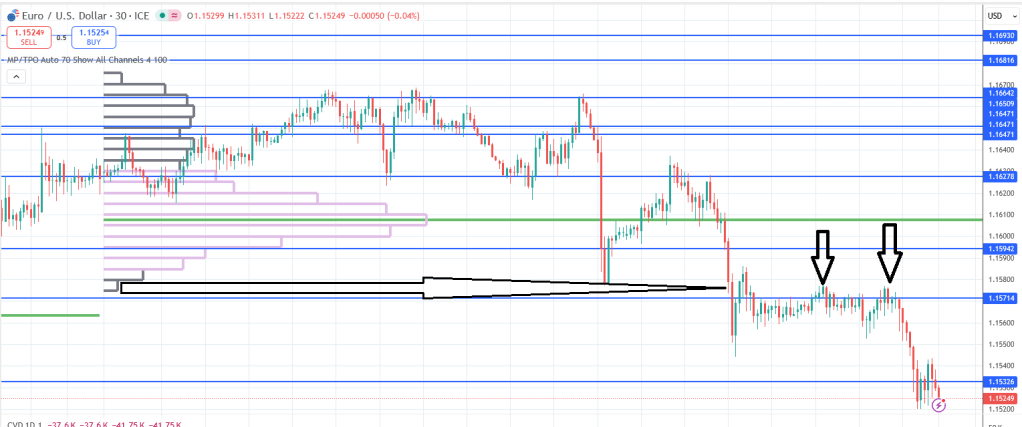
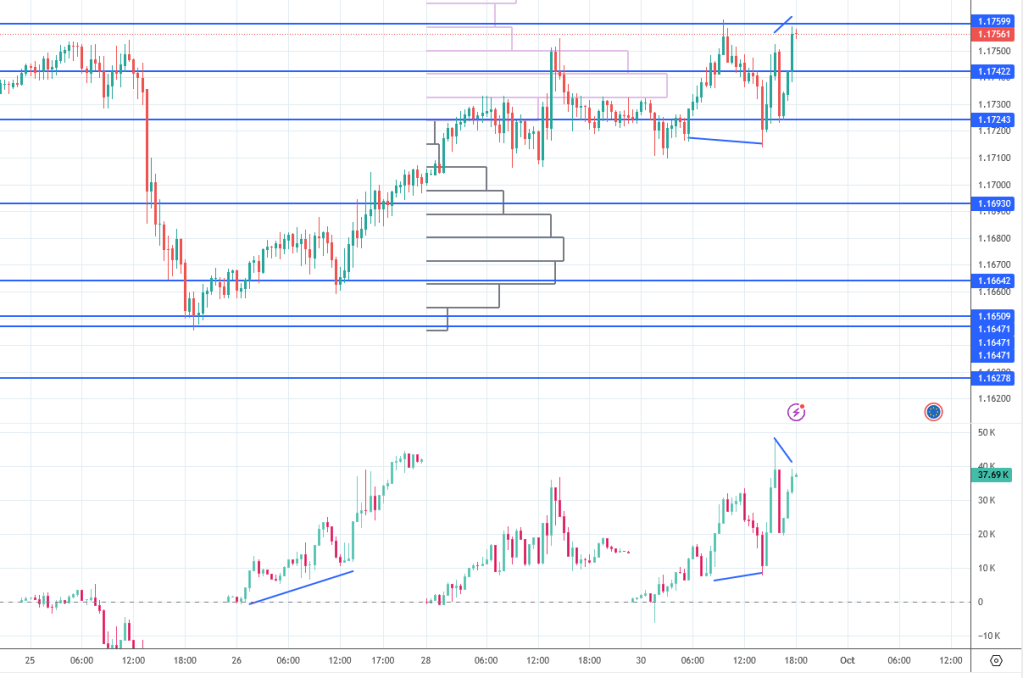
Looking at the Cumulative Volume Delta, you can see that Friday was a strong up day, buying from the start to the end, almost on the high.

Of course, still outside the prior volume block.

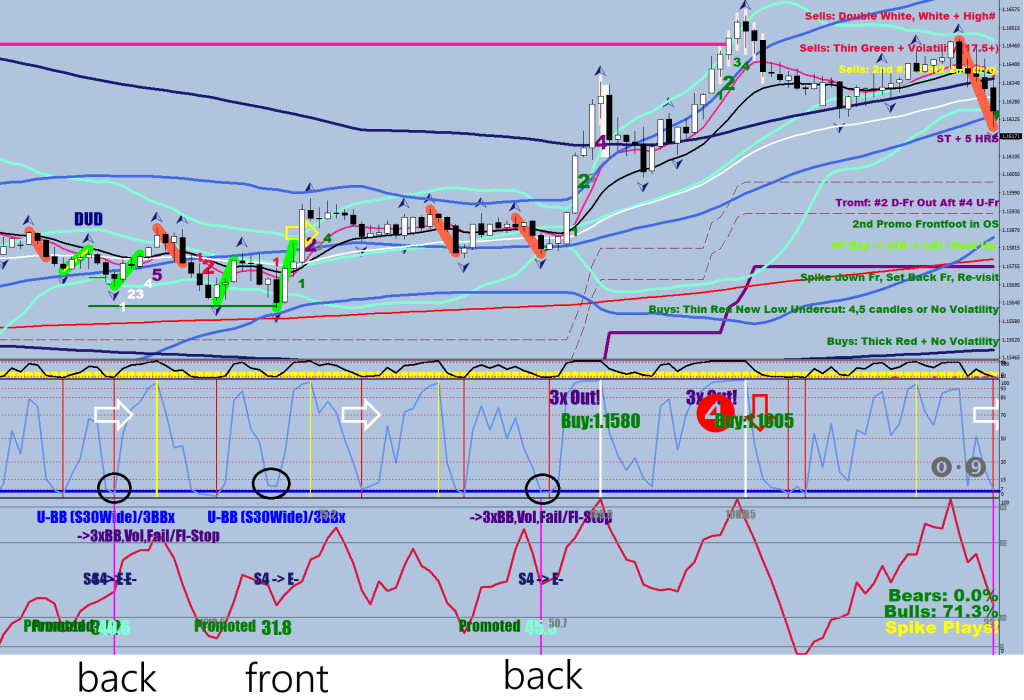
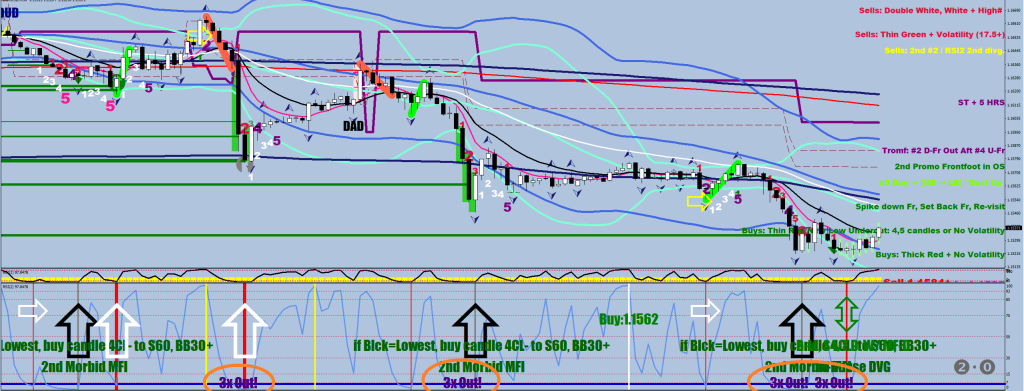
Now, my colored MFI divergence highlights are a good idea to start with, but it is tiresome going back and forth between 30-min and 1H just to get a picture of the volatility-compression readings. So, more text was my answer.

As you can see the red / bear line is over the bull line, which can be a crucial final information that tips the scale. The high of that candle is a promoted sell.

Next up, a Demoted buy.

Of course, things can get more nuanced than that.

For instance, a low volatility turn sequence plots first a “where” spike out of the 30 BB (triangular plots) then the “when” receives its plot (vertical highlights), and if the where block is unable to break through the peak of the triangle, that’s a priority turn.

As you can see, the Demoted supplementing flag was incorrect. 4 hours later, the Bears managed to overcome the Bulls. Time/sample size is just as important as the price level. No New HH.

Here’s one more example of a low-volatility turn.

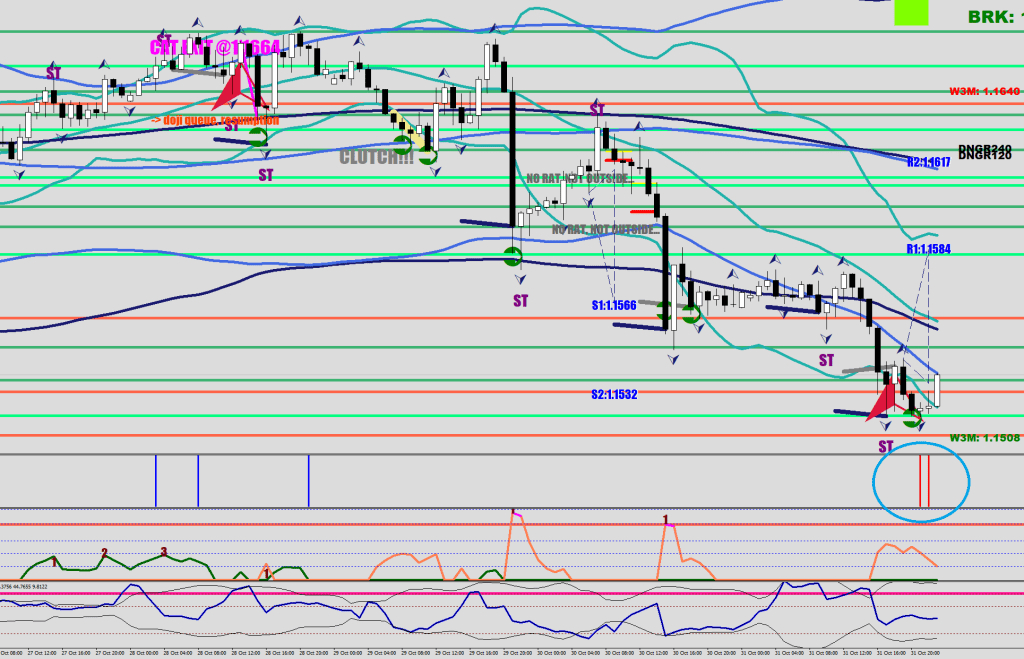
No new LL.

///fractal MFI below
if (i>0  && Close[i+2]>Low[i] && Low[i+1]>Low[i] && Low[i]<iBands(symbol,0,30,2,0,PRICE_MEDIAN,MODE_LOWER,i) && Close[i-1]>iBands(symbol,0,30,2,0,PRICE_MEDIAN,MODE_LOWER,i-1)-20*Point && Low[i-1]>Low[i]-20*Point ){
   MFIDMEM[i]=MFI[i];
    ObjectCreate("Caligula"+IntegerToString(i),OBJ_TEXT, 3, Time[i],25);
    ObjectSetText("Caligula"+IntegerToString(i),DoubleToStr(NormalizeDouble(MFI[i],1),1), 16, "Impact", clrGray);
    if (MFIDMEM[i+1]<MFIDMEM[i] && MFI[i]<48 && MFI[i]>26 && (RSI2[i]<10 || RSI2[i]>20)) {ObjectSetText("Caligula"+IntegerToString(i),DoubleToStr(NormalizeDouble(MFI[i],1),1), 26, "Impact", clrGreen);
    ObjectCreate("Caligulas"+IntegerToString(i),OBJ_TEXT, 3, Time[i],95);
    ObjectSetText("Caligulas"+IntegerToString(i),"U-BB (S30Wide)/3BBx", 22, "Impact", clrBlue);
         if (ExtATRBuffer2[i+1]>ExtATRBuffer[i+1]) {
                 ObjectCreate("Caligulazz"+IntegerToString(i),OBJ_TEXT, 3, Time[i+8],25);
                 ObjectSetText("Caligulazz"+IntegerToString(i),"Promoted", 22, "Impact", clrMidnightBlue);
          }
          else {
                 ObjectCreate("Caligulazz"+IntegerToString(i),OBJ_TEXT, 3, Time[i+8],25);
                 ObjectSetText("Caligulazz"+IntegerToString(i),"Demoted", 22, "Impact", clrMidnightBlue);
          }
     ObjectCreate("Caligulasz"+IntegerToString(i),OBJ_TEXT, 3, Time[i],55);
    ObjectSetText("Caligulasz"+IntegerToString(i),"S4 -> E-", 22, "Impact", clrMidnightBlue);
     if (RSI2[i]<5) {ObjectSetText("Caligula"+IntegerToString(i),DoubleToStr(NormalizeDouble(MFI[i],1),1), 26, "Impact", clrAquamarine);
          if (ExtATRBuffer2[i+1]>ExtATRBuffer[i+1]) {
                 ObjectCreate("Caligulazz"+IntegerToString(i),OBJ_TEXT, 3, Time[i+8],25);
                 ObjectSetText("Caligulazz"+IntegerToString(i),"Promoted", 22, "Impact", clrMidnightBlue);
          }
          else {
                 ObjectCreate("Caligulazz"+IntegerToString(i),OBJ_TEXT, 3, Time[i+8],25);
                 ObjectSetText("Caligulazz"+IntegerToString(i),"Demoted", 22, "Impact", clrMidnightBlue);
          }
          
          
    ObjectSetText("Caligulas"+IntegerToString(i),"->3xBB,Vol,Fail/Fl-Stop", 22, "Impact", clrIndigo);
     }
    }
}

///fractal MFI above
if (i>0 && Close[i+2]<High[i] && High[i+1]<High[i] && High[i]>iBands(symbol,0,30,2,0,PRICE_MEDIAN,MODE_UPPER,i) && Close[i-1]<iBands(symbol,0,30,2,0,PRICE_MEDIAN,MODE_UPPER,i-1)+5*Point && High[i-1]<High[i]+20*Point){
   MFIUMEM[i]=MFI[i];
    ObjectCreate("Caligula"+IntegerToString(i),OBJ_TEXT, 3, Time[i],95);
    ObjectSetText("Caligula"+IntegerToString(i),DoubleToStr(NormalizeDouble(MFI[i],1),1), 16, "Impact", clrGray);
    if (MFI[i]>68 && MFI[i]<75 && RSI2[i]<96 ) ObjectSetText("Caligula"+IntegerToString(i),DoubleToStr(NormalizeDouble(MFI[i],1),1), 26, "Impact", clrBlue);
    if (MFIUMEM[i+1]<MFIUMEM[i] && MFI[i]>52 && MFI[i]<71 && RSI2[i]<96 ) {ObjectSetText("Caligula"+IntegerToString(i),DoubleToStr(NormalizeDouble(MFI[i],1),1), 26, "Impact", clrRed);
     if (ExtATRBuffer2[i+1]<ExtATRBuffer[i+1]) {
                 ObjectCreate("Caligulazz"+IntegerToString(i),OBJ_TEXT, 3, Time[i+8],75);
                 ObjectSetText("Caligulazz"+IntegerToString(i),"Promoted", 22, "Impact", clrMidnightBlue);
          }
          else {
                 ObjectCreate("Caligulazz"+IntegerToString(i),OBJ_TEXT, 3, Time[i+8],75);
                 ObjectSetText("Caligulazz"+IntegerToString(i),"Demoted", 22, "Impact", clrMidnightBlue);
          }
   }

If this is a low volatility turn – and I don’t think it is (- a stall), it would still have to test back into that triangle at least once. A lower low would mean a high volatility turn though.

There is a well-defined failure area between 1.1622 and 1.16, the prudent area to pick up a hedge / close shorts. The BRK level should remain untouched. If it blows past, you are in a Wave 3 down, and a new measuring leg just started printing.


After a while, it may pose a challenge to surprise yourself with what you can do in music. I am managing to do it still.


After a volatility compression anchor print, there should be a divergence, weaker compression achieved at a lower low.

4%

I’ll show you something neat. Remember the circled menu item?

Below was the inspiration for enlisting it.

This much about fractals, a 30-minute chart, and a 30-sample BB.

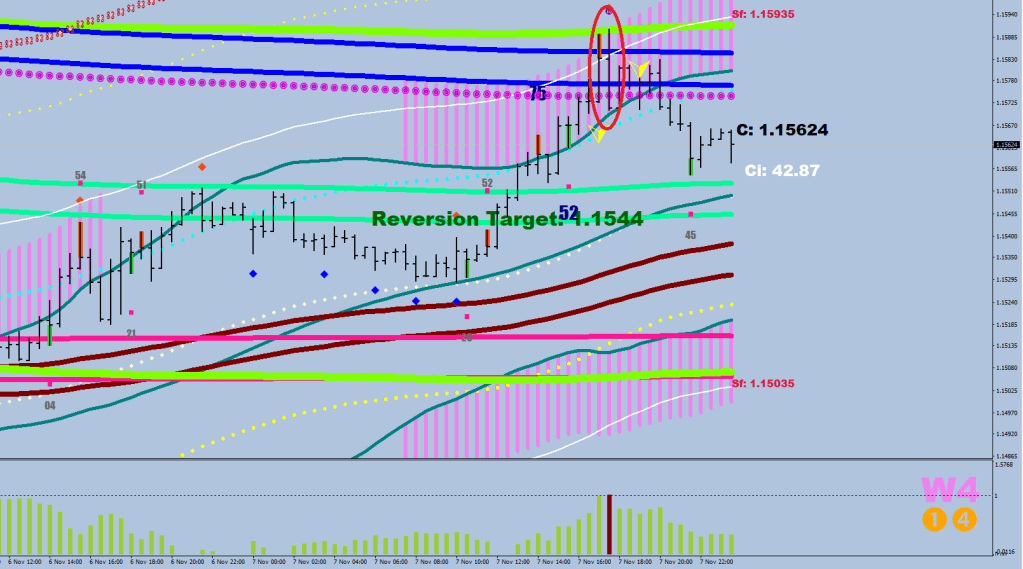
Next thing – 60 sample stochastic on the hourly. Highlights for the last 4-percentile.

 if (i>0  && stoch60[i]<4)
   {
       ObjectCreate("DOTS"+i,OBJ_TEXT, 1, Time[i+1],(ExtATRBuffer2[i])+25);
        ObjectSetText("DOTS"+i, DoubleToStr(NormalizeDouble(stoch60[i],1),1), 16, "Impact", clrDarkGreen);
   }  
   
  if (i>0  && stoch60[i]>96)
   {
       ObjectCreate("DOTS"+i,OBJ_TEXT, 1, Time[i+1],(ExtATRBuffer2[i])-15);
        ObjectSetText("DOTS"+i, DoubleToStr(NormalizeDouble(stoch60[i],1),1), 16, "Impact", clrCrimson);
   }  

It does not always prompt an immediate reaction, but the countermove also holds predictive value.

For instance, a shallow pullback to the E-30 is a great continuation entry.

Otherwise, I have a couple of examples with an 86-pip counter move first.

This is a tough call with the Bulls and the Bears converging, being neck & neck.

The Bull / Bear strength plotter I came up with yesterday. Not sure how it would be useful, but I felt the need for it.


if (ExtATRBuffer<30) bulls=(100-ExtATRBuffer+20)/30*25;
else if (ExtATRBuffer>=30 && ExtATRBuffer<47) bulls=(100-ExtATRBuffer+26)/17*9+25;
else if (ExtATRBuffer>=47 && ExtATRBuffer<135) bulls=(100-ExtATRBuffer+36)/88*41+25;


if (ExtATRBuffer2<30) bears=(100-ExtATRBuffer2+20)/30*25;
else if (ExtATRBuffer2>=30 && ExtATRBuffer2<47) bears=(100-ExtATRBuffer2+26)/17*9+25;
else if (ExtATRBuffer2>=47 && ExtATRBuffer2<135) bears=(100-ExtATRBuffer2+36)/88*41+25;


ObjectCreate("LEVELOPE"+29,OBJ_LABEL,3, 0,0);
  ObjectSet("LEVELOPE"+29,OBJPROP_CORNER,3);
    ObjectSet("LEVELOPE"+29,OBJPROP_XDISTANCE,0);
  ObjectSet("LEVELOPE"+29,OBJPROP_YDISTANCE,60);
  if (bulls>bears) ObjectSet("LEVELOPE"+29,OBJPROP_COLOR,clrGreen);
  else ObjectSet("LEVELOPE"+29,OBJPROP_COLOR,clrCrimson);
  if (Period()==60) ObjectSetText("LEVELOPE"+29,"  ",24,"Arial Black");
   else ObjectSetText("LEVELOPE"+29,"Bulls: "+DoubleToStr(NormalizeDouble(bulls,1),1)+"%",24,"Arial Black");

ObjectCreate("LEVELOPE"+30,OBJ_LABEL,3, 0,0);
  ObjectSet("LEVELOPE"+30,OBJPROP_CORNER,3);
    ObjectSet("LEVELOPE"+30,OBJPROP_XDISTANCE,0);
  ObjectSet("LEVELOPE"+30,OBJPROP_YDISTANCE,90);
  if (bulls>bears) ObjectSet("LEVELOPE"+30,OBJPROP_COLOR,clrGreen);
  else ObjectSet("LEVELOPE"+30,OBJPROP_COLOR,clrCrimson);
  if (Period()==60) ObjectSetText("LEVELOPE"+30,"  ",24,"Arial Black");
   else ObjectSetText("LEVELOPE"+30,"Bears: "+DoubleToStr(NormalizeDouble(bears,1),1)+"%",24,"Arial Black");

Bar The Door

The last time the Bulls were in the volatility compressor (aka Tool Shed) was Sept 9-11.

Notice that the Bears are also in the shed, and except for the last 6 hours, they were worse off, more beat down.

This time it is different.

The Bulls are in solitary confinement and are about to get it. This condition was last observed on August 28.

People are always trading the last trade. I see no bottom, I hear no bottom. The momentum has barely started coming on.


History’s worst murderers


The other thing was the deep disappointment in the YouTuber I used to have sympathy for. When he started shilling Sven’s take on the S&P – the monthly low was made on the first day of the month for many months, trying to steal credits, I had to realize that this Brian Shannon slogens boosted ego trip guy has folded under the pressure of having to show for, and all of his outrageous performance claims belong in that too good to be true bucket borrowed from the Scammer Supplies.

Zero Edge

You have seen a mean reversion from a 4x fluctuation stretch. The projection was 1.1750

The shorts and the longs converged. Both parties are outside the beating area / the tool shed.

The price has been positioned above the market profile.

The small hint here is that there is no bounce back up happening, and the volatility breakout to the downside is a short breath away, still at 1.1741.

I have thought of talking about energy principles again, just have not had the time.

With the help of the CI (12-sample), it is easy to spot if a move is discharging energy (pushing) or consolidating it (relieving).

thinking trader

As I was asked, here’s what I said before the FOMC.

Now, if only I had looked at my desktop charts in the last hour, I could have nailed the exit scale out. I did sell out 0.5 lot at 1.1913 still.

The deflector dropped to 1.1914. I would have had orders at every single pip above.

Do we have a top? You bet your sweet ass.

S4 is 16 pips below S3, which is approximately 1.1806.

1.1741 is the volatility punch bag wuthout consolidation.