Aleš’s Lessons #21 – Considerable Events

I want to point out two pieces of useful information today.

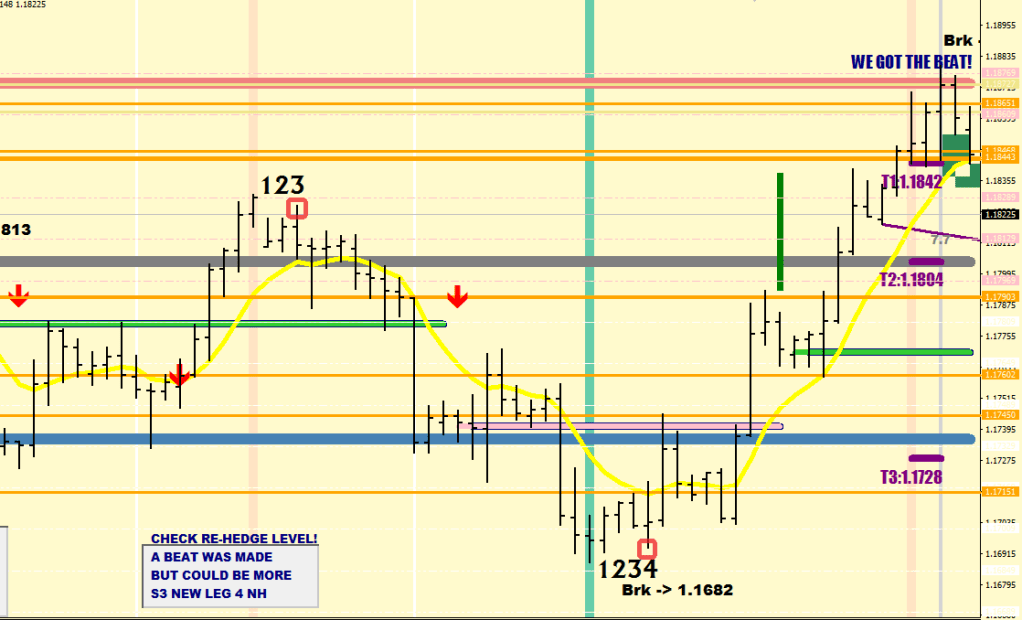
1st: it is helpful to understand a level that does not have a plot of any kind, yet is very informative in trading.

Try not to pay attention to the yellow high lights, they have their own logic, but don’t take them on as your bias.

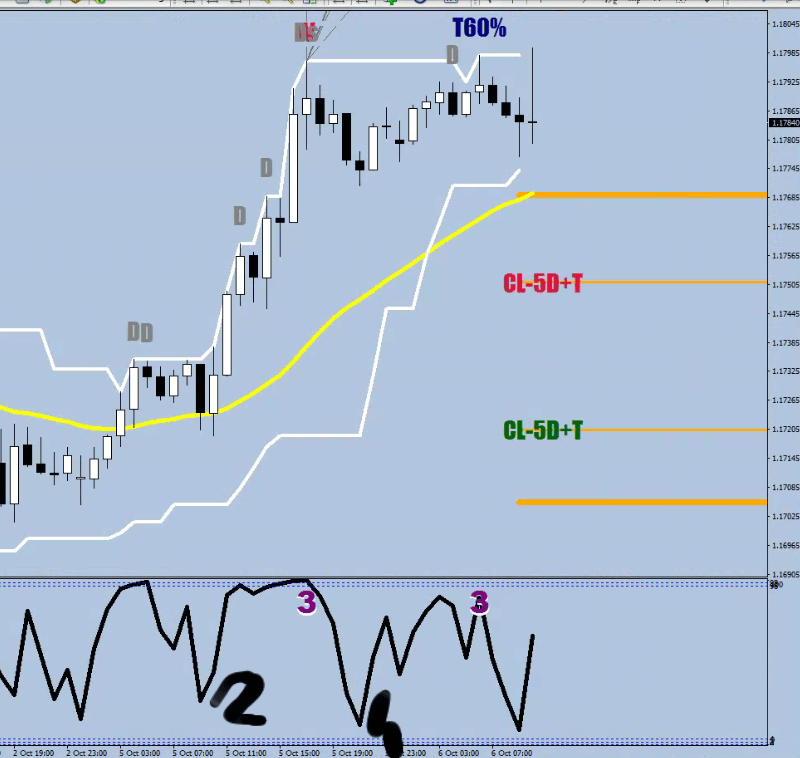
Pay attention to the relationship between the ovalled numbers and the levels where the market throws in the towel / is experiencing great difficulties to proceed.
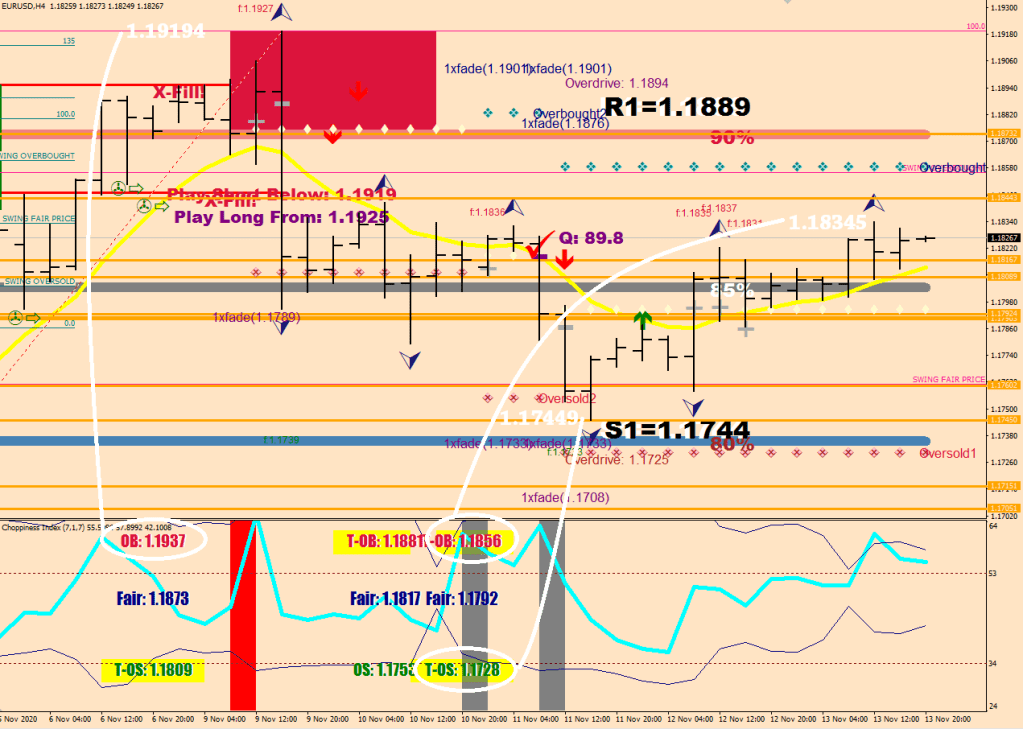
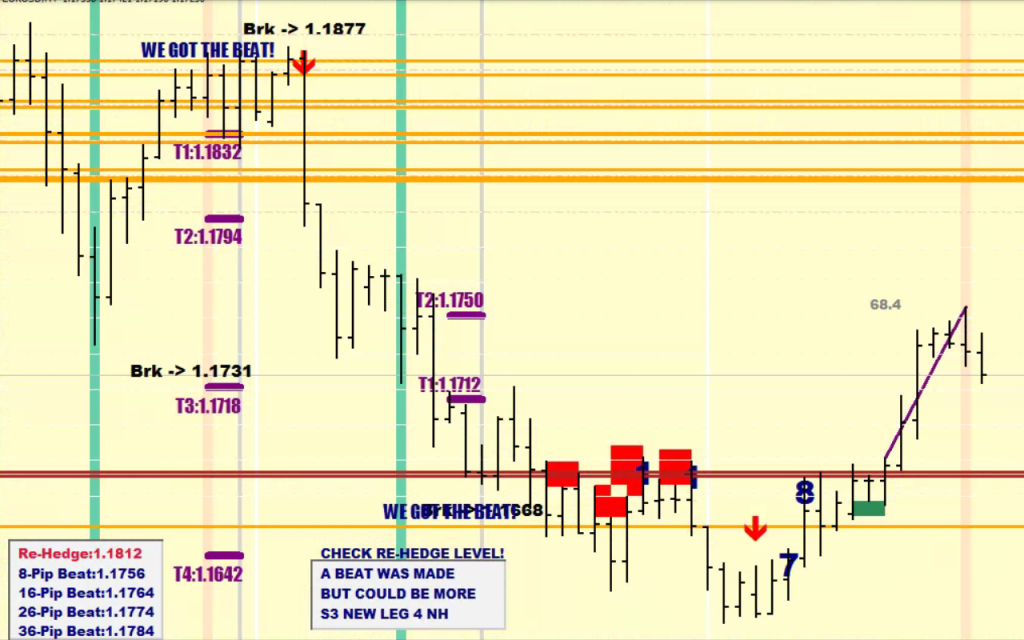
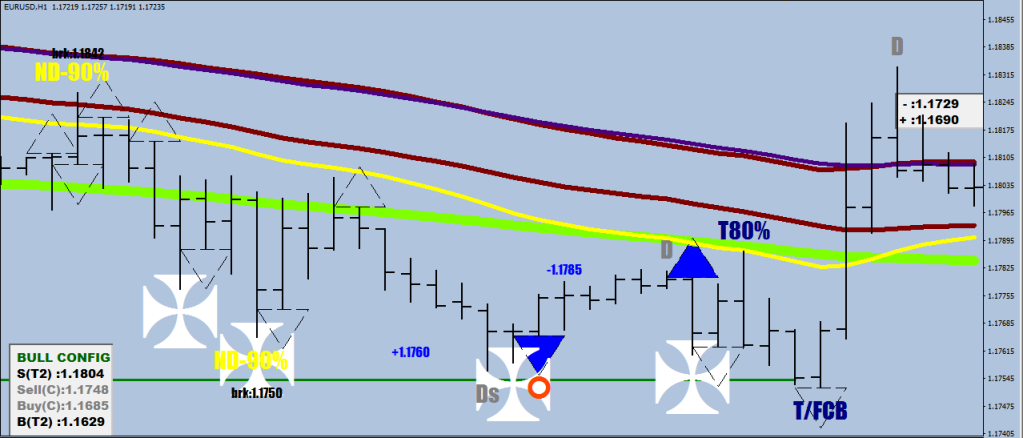
Actual high on Friday was 1.18368 + .002 = 1.18568 – circled white.

If you came up with an approximate number of 20 pips shy, congratulations.

This distance is the instrument dependent distance from the consolidation weight known as fluctuation maximum (I refer to it as sound barrier on occasions). Only a Wave 3 has the ability to clear this level.

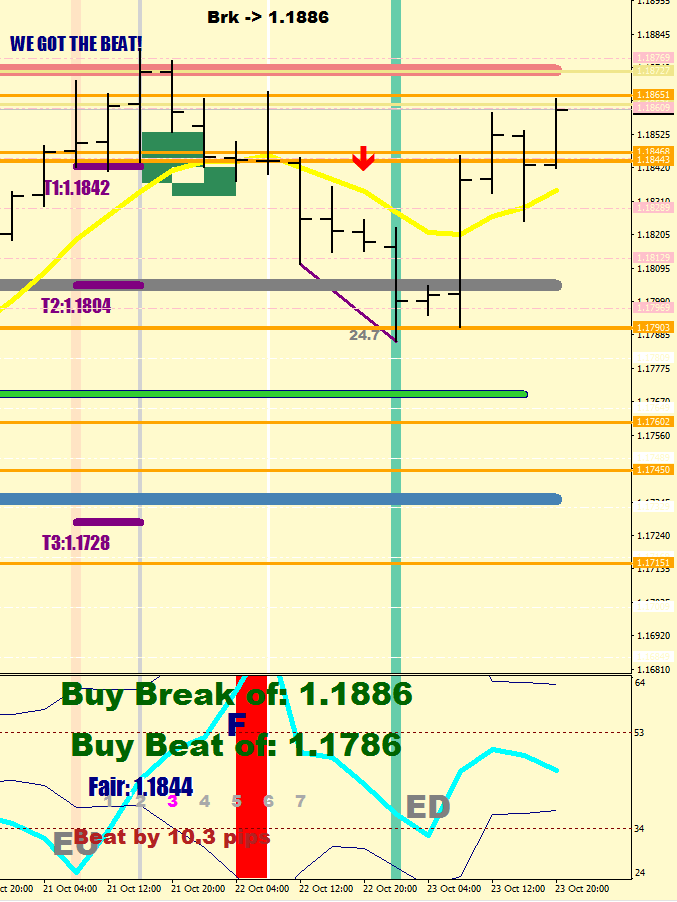
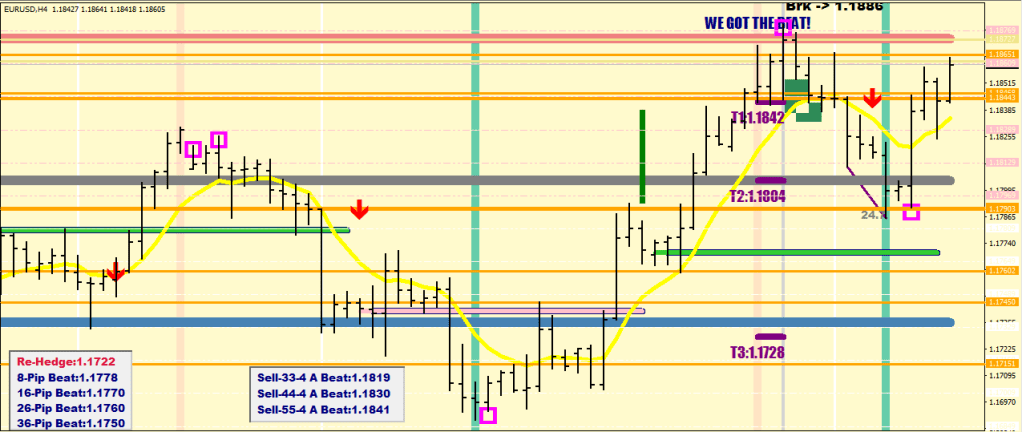
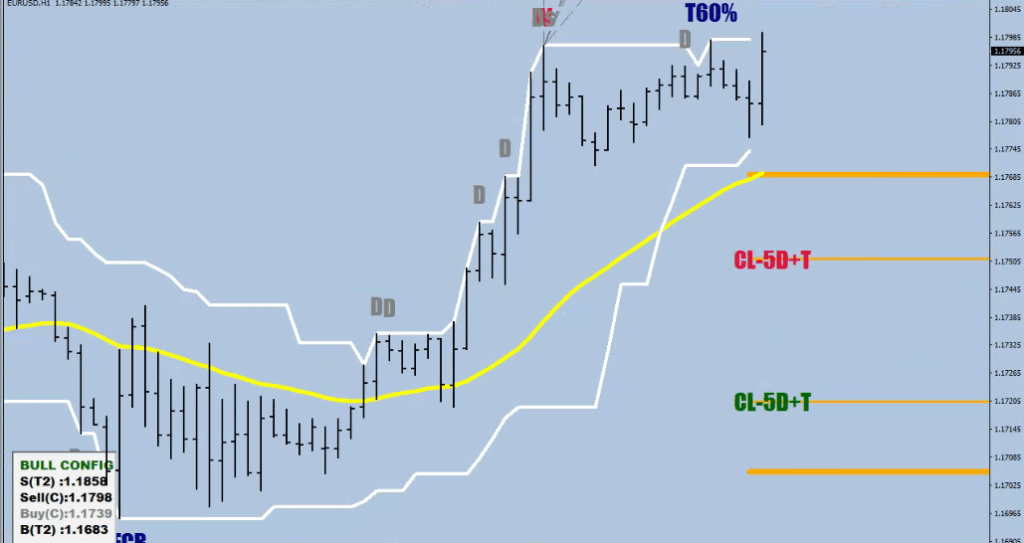
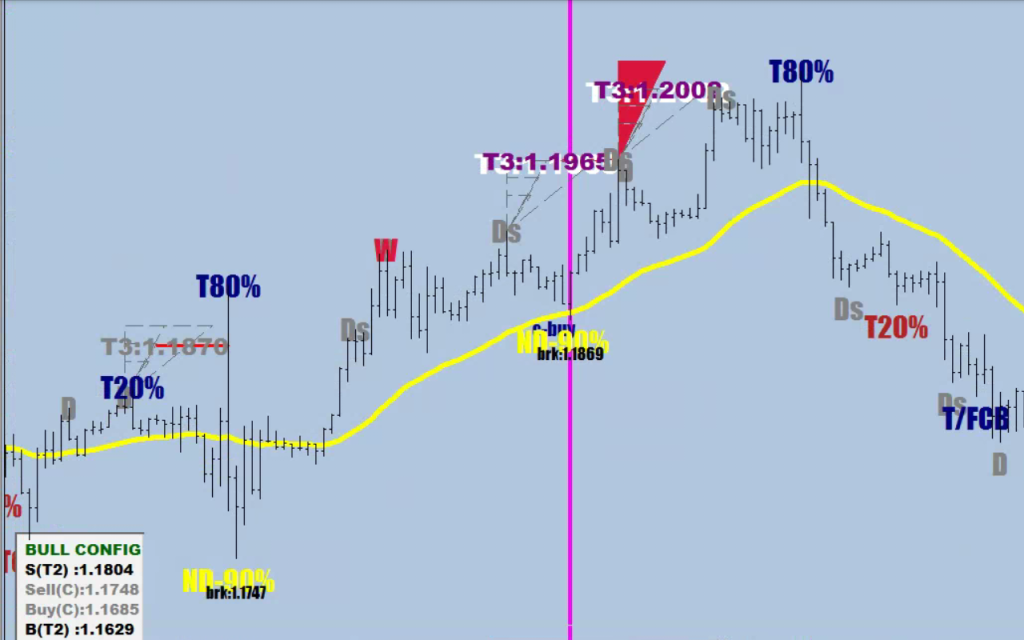
2nd thing is the 12-sample bracket. Learn to think like this:

Plateau – break; plateau – fade
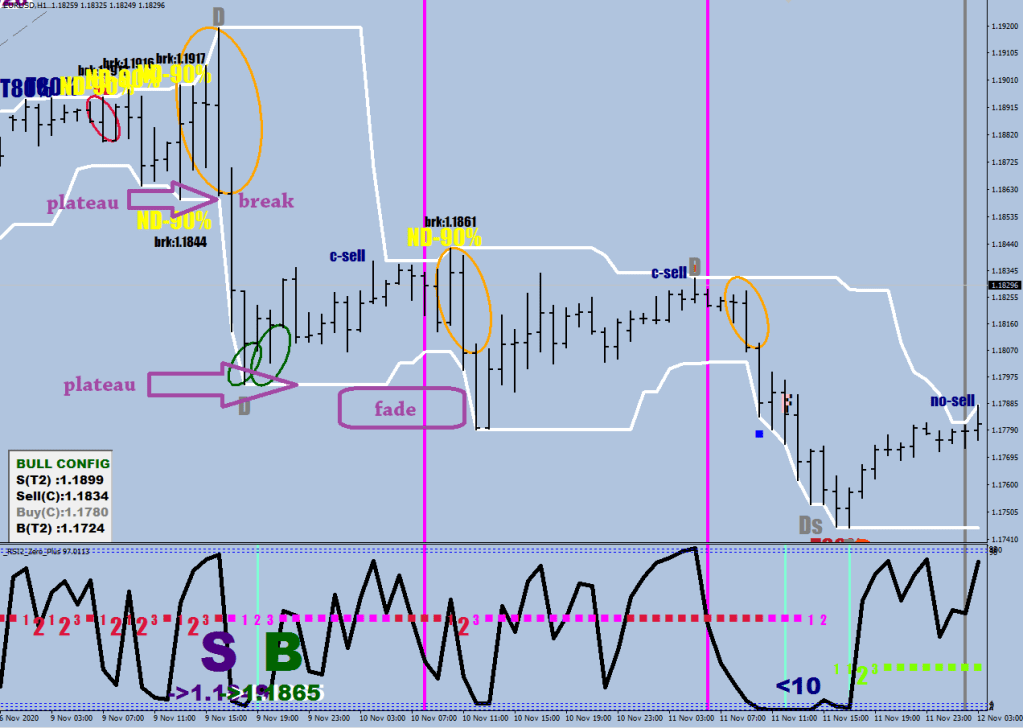
When you had two of these occurring back to back, try to suspend enforcing continuation sells / buys

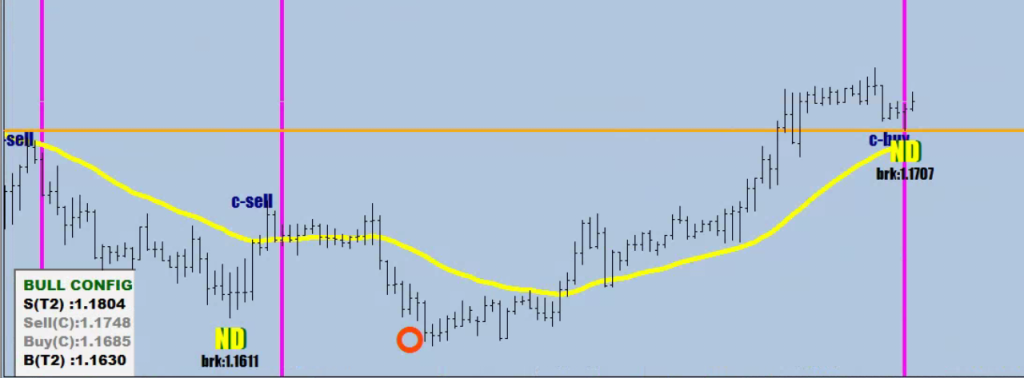
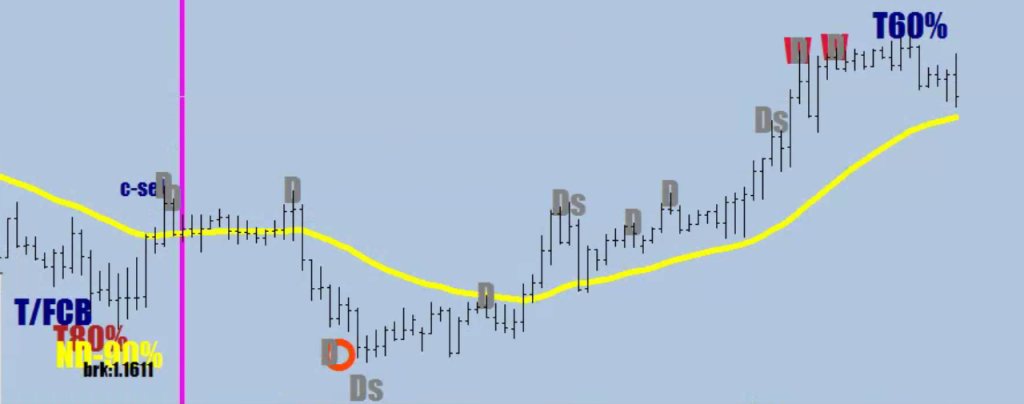
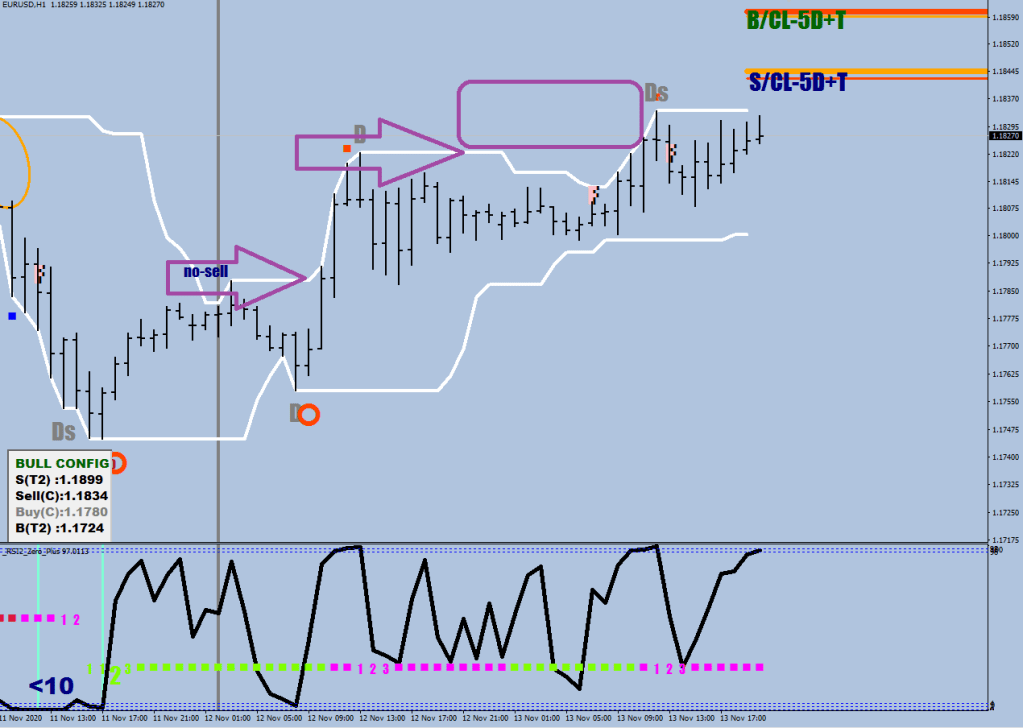
an example from the upside as well

You had 5 wolf cries before the the moratorium of the last NoDrive call choked and reversed price for good.
property copyright "by Macdulio"
 property link      "forexfore.blog"
 property description "12-sample high & low"
 property indicator_chart_window
 property indicator_buffers 2
 extern int lookback = 300;
 int       Range_n=12;
 double HighBuffer30[];
 double LowBuffer30[];
 //+------------------------------------------------------------------+
 //| Custom indicator initialization function                         |
 //+------------------------------------------------------------------+
 int init()
   {
 SetIndexBuffer(0,HighBuffer30);
    SetIndexStyle(0,DRAW_LINE,2,4,White);
 SetIndexBuffer(1,LowBuffer30);
    SetIndexStyle(1,DRAW_LINE,2,4,White);
 //----
    return(0);
   }
 //+------------------------------------------------------------------+
 //| Custom indicator iteration function                              |
 //+------------------------------------------------------------------+
 int start()
 {
 int    i;             // Number of counted bars
 string symbol = Symbol();
 ArrayResize(HighBuffer30, Bars);   
  ArrayInitialize(HighBuffer30, EMPTY_VALUE);  
 ArrayResize(LowBuffer30, Bars);   
  ArrayInitialize(LowBuffer30, EMPTY_VALUE);  
 //--------------------------------------------------------------------
    for (i = lookback ; i >0; i--) {      HighBuffer30[i]=HighBuffer30[i+1];      LowBuffer30[i]=LowBuffer30[i+1];      HighBuffer30[i]=iHigh(symbol,0,iHighest(symbol,0,MODE_HIGH,Range_n,i));      LowBuffer30[i]=iLow(symbol,0,iLowest(symbol,0,MODE_LOW,Range_n,i));   }
 return(0);
   }
Aleš’s Lessons #20 – Terzo Elemento

Another Level 3 article.

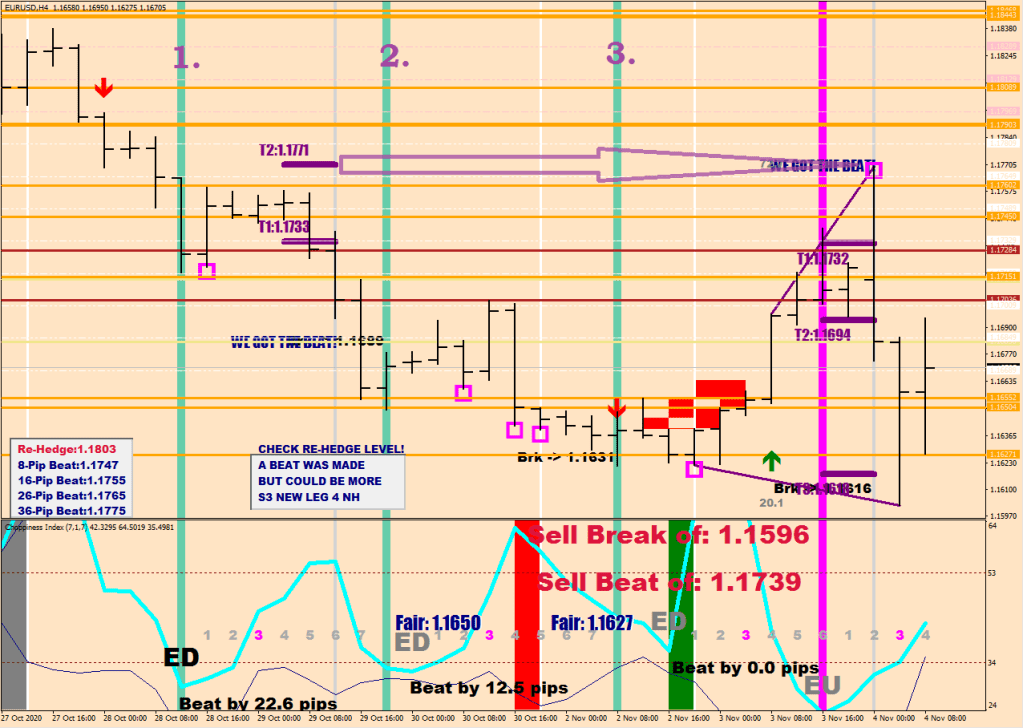
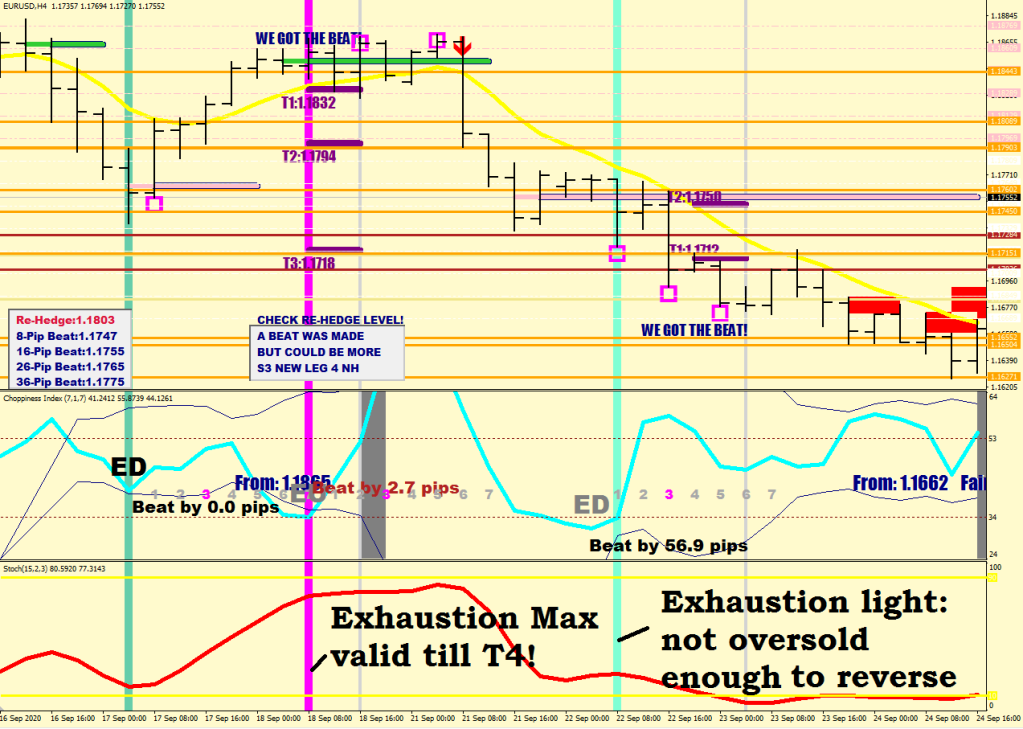
What is going on with the downside, why can there be multiple exhaustions and which one to take seriously?

The picture below shows 3 deep exhaustions. Any of them could had been final, but something was missing. What?

The beat of the first exhaustion provided the target level of 1.1771. After that I was not curious of the beats. I wrote the routine like that intentionally.

You have to move the exhaustion low to the 1H chart in your mind, and then tell me, what did not happen all the way down from 1.1728 to 1.1640-?

There was no thrust, so the low could not be trusted (the white stuff).

On the way up the beat coincided with the thrust. T3 was filled.

So what’s the Level 3 answer for finding the market top / the market bottom?

  1. Primo Elemento: 4H Exhaustion
  2. Secondo Elemento: Beat / Beat Attempt
  3. Terzo Elemento: Thrust / No Drive

Aleš’s Lessons #19 – Trading Menu

This is a Level 3 article, no outsider would have a clue of what I’m talking about here.

Trading Menu

  1. 1xFade – scale in with large size, target 20 pips+ from entry.
    Exception is when the call levels had no effect in the opposite direction.
  2. Driven Thrust + Full Charge (Pink F) – Target T2 if Wave 3, Beat if Wave 5 ___________________________________________________________________________
  3. Exhaustion Beat / Exhaustion + Beat Attempt – play the decisive direction according to color depth and to final or intermediate status target beat-T2(700+), beat-T3, beat-T4.
  4. Fade T3 failure target Green Mean, OD(T2)
  5. High charge + Swing Fair price failure – continuation move trade target the new Fade1.
  6. A Bottom / A Top Continuation trades & swing overbought / swing oversold target opposite 20/80, OD(T2)
  7. Fade T2 (overdrive) failure after Crack Ho 94+ or 9.4- print target 0 Lucid, Green Mean.
  8. Fade consolidation overbought / oversold Failure (yellow square + target listed)
  9. Price in Recent No Drive Moratorium (ND +- 5, 10, 15 pips for entries) target E89, T2

Call levels had no effect – Fade Ruled Out

As a reminder here are the tick-tick-wick snapshots.

Aleš’s Lessons #18 – Sophistication

Sophistication comes with being able to distinguish between say a top and the top.

After a top you want to be playing the upside still by buying low, while after the top you want to sell high. This is where all tend following systems would end up putting you on the wrong side.

The spohisticated method is plotting a CI DV on a 4-hour chart to find exhaustions, beats and beat attempts and making a stochastic (crack ho) comparison to find reversal divergences.

The following image shows how to spot a beat attemp – for the beats are automatic plots anyways.

On this image you are looking at the top, the bottom and the top (the last one had a valid beat).

The next step is to make the comparison. The Crack Ho would come out to be a 15-sample high-low stochastic signal with 3 smoothing and 2 delay, but that’s a bit crude, so I would look fir those two wicks on the hourly chart and use the Crack Ho straight up.

There is one more thing. The exhaustion itself has to be qualified by the Crack Ho being above 90 or below 10. Otherwise you are looking at a top or a bottom by default.

This is how the exhaustion (second image) on the left that coincided with the beat represented a top and thus the T2 target wasn’t hit versus the one on the right which was the top.

Back testing the consolidation mean at 1.1844

overbought still starting at 1.1854

more automatisation – magenta beat attempts

Aleš’s Lessons #17 – Bee Gees & Fugees

Let’s re-invent the thrill!

What is the number one concern for your trading account?

Stayin’ Alive!

If you could have only one indicator to make decisions about where to open a trade, what would it be?

Choppiness-Mac, that’s right.

Ready or not, here I come!

  1. The 1x fade got a plot correction based on the Fugees “one time” count.

20 pips into the overbought / oversold field you can bet on the back test of the current consolidation range’s overbought / oversold level, and a certain 20-pips move is nothing to sneeze at when the certainty is high. Scaling / adding to the position moving further against you is advised, for the first penetration into the overbought / oversold would get rejected back. Do not try to go in at the same level again.

2. The new yellow highlights are to call attention to the Quick Picks / Lucky Dips depending on which country you are calling from. Now with added T>arget prices.

3. The full consolidation targets that are highlighted on the bottom, you are already familiar with.

Don’t forget to apply protective stop losses when in gains.

You would no longer have to feel like J. P. Gaultier wishing for a trading idea.

Projected distance – speaks of the fractal nature of a wave structure – patented to my name

This move has performed what it had promised

Appendix

Elon & Melon

Warning! Off topic entry! Read it only if you speak British and your nerves are made of aluminium or if you speak American and your nerves are made of aluminum.

Elon Musk and Melon Husk were born in the early seventies.
They both were exceptionally bright kids.
Then they both had to wrestle their father to the ground to stop that drunkard animal from being able to apply the knife blade that was cast inside a large thigh bone on various family members.
“You are not my son!” – was the cue, and so they found themselves having to pay for their accommodation and trying to make money on the streets at the age of 17. We skip out on the 12 years of vegetarianism and only vaguely mention the influence of Douglas Adams, who triggered the 42 mania and contributed to humanity the “Don’t Panic” attitude. Melon went all out and ended up translating most of his books – no, not to Afrikaans.
Both guys ended up in California. They both got married at least once and had at least one kid of a gender. They both understood that hyperloop would never work under any circumstances, but Elon had to first see thousands of attempts fail before having to re-purpose the underground tunnels he already started digging.
At the age of 37 they both had a net worth of at least $265,000 and by the age of 40, they both had at least £17 to their names. They ultimately had to leave the USA due to an expiring visa. Actually, the two stories differ a bit from here on.
Financial success in life does not have to do with the level of intelligence.
First and foremost it hinges on one’s personality, then on who they know, the authority to act and sheer luck.
I wish you a bunch.

I wanted to insert here the picture of Jules Verne’s (Verne Gyula) moon shuttle that I took in Washington D.C., but could not find it.

Here’s the book cover of the Plague From Space by Harry Harrison instead.

All of the following images are links.

& also, for good measure The Stainless Steel Rat Goes To Hell

The Keepers of the Maser

Techno Priests

Wake

Aleš’s Lessons #16 – Crack Ho Cropper

Remember those >94, <10, <6 signs?

They can be utilized for a perfect exit.

With the addition of code 94 – which means 0.94 stop loss on a long and 9.4 stop loss on a short now it is possible to have a near perfect exit.

Until now targets could be set dynamically to a moving average or a displacement of a moving average (overdrive lines).

With the new cropper routine you can be sleeping in the middle of the night or be roaming somewhere out of coverage whilst the home computer is taking care of the optimal exit business.

What you need to remember is a good exit isn’t always the best entry for a reversal. When things get overheated, stochastics can embed for a while and at times only the second >94 or <10 would bring about an optimal entry.

Now these lines are part of TrailStopOnlyModifiedLT, which clearly isn’t a Trail Stop Only, but rather a Swiss Army Knife.

I find myself switching off among the various SL codes based on my latest analysis. I may open a trade manually and give it an Overdrive line target (code 8) then upon realising that a continuation against me is a bigger likelihood now, I would change the “stop loss” code to E16 or E32 (code 5 or code 6).

Having optimised automatic entry is a power just as much as having a 1/2 and full automatic hedge for a black swan event to prevent the account from being blown and possibly capturing it at a workable condition still.

Other – I ended up having to highlight the oversold end of the last consolidation as well, if the 4H RSI2 is below 14 when reaching a full charge, the selling already embedded:

I do expect the consolidation mean (fair price) to be attacked again, and if crossed, the other end becomes in plans.

Aleš’s Lessons #15 – From Cluelessness to Cluefullness

Blue’s clues should had been the following:

When price failed to sustain a move below the No Drive Break level 3x in a row, that meant inability to go lower = HIGH BASE.

I managed to over think that one and figured it was a temporary act that had to do with some Friday options expiration – don’t do that.

Clue #2 was price not breaking the Maroon Fake out level circled in green.

When what should happen, doesnt’t, remember the name of Peter Reznicek.

Clue#3:

There is 3G, 4G and 5D+T. No, this one does not cuse cancer, and you don’t need to send me Bitcoins, I won’t double them.

CL is short for CLue. 5D plus a Thrust was the potential after price went beyond the lower ND level, faked out the break level a few times and then returned back the slim orange line.

The back 2 back D-s (next to candle) should be counted as one, I applied multiple logic not to miss one. Not sure why 5 exactly, but this is the 3rd sequence like that in recent times.

Clue #4 was spotting the impulsive wave and calling it 1.

You may be at a disadvantage when looking at only bar charts: the white block showed no pullback. The pullback following was Wave 2 down. It is a clue by itself when price returns to Zero Lucid (E67 HL2 / Maroon Median).

Clue #5 was breaking the De Tomaso Maroon Fake out. Find the image earlier on this page.

Besides having a clue about the 5D+T and looking at the 4H energy for an exhaustion beat

a further clue of the timing was the wave structure itself.

The relationship between the end of Wave 2 and Wave 4 is a continuation divergence, in this case higher low with lower RSI2 reading

The two automatic #3s are the End of Wave 3 and the end of wave 3 of Wave 5 up. Both beats were as weak as possible.

One clue I forgot to mention about is that a awave 3 likely ends up exceeding the 3-Day ATR (measited from the last 15-min consolidation weight – plots by 15-Min ATR PRO and other indicators). That is exactly what happened yesterday upon reaching beyond 1.1790, which served up the clue of a No Break Extension for the next day.

The triple beat hurdy jerky move recharged the 4H energy completely.

The weight migrated to 1.1791

T1..T4, T2 filled

The day that was the 6th of October, 2020

Featuring Simple Ton #2

Fundamentals are bullshit*

A half hour engulf is an effin 1-hour hammer
Once you figure that out, you’d say: candlesticks are just a matter of time frame

to scale in and scale out is the holy grail
and to not really give a fuck is the other holy grail

* 14% of all trading can be currently classified as fundamental trading (info: Bloomberg, 2020), and this does not qualify their rate of success

Infinite profit factor means just that. Alchemy, money out of thin air.

Aleš’s Lessons #14 – No Drive Moratorium

The ND moratorium is a 15-pip zone between the Break and ND where the No Drive edge is still in effect.

Let’s re-introduce the thrust function.

Better. I grayed the Drives out so you can more easily derive the conclusion that the buying spree from the ND low lasted until a thrust was made on the upside.

We have seen this movie before:

The Drives are peak buying/selling just as the Thrusts are, but the Thrusts cannot muster more than 2 hours’ worth.

ND is very much like an exhaustion beat. The gray line on the upside was exceeded somewhat, but not all the way to the break level = in the moratorium.

How did you like the T4 plot on the way down? How did you like the T2 plot on the way up for target on the upside? Yes, in this case there was a break of the beat, but this did not change the target levels, just pushed back the entry.

So let’s count your blessings edges.

ND (+moratorium)

Thrust (terminal correspondent of the ND)

Exhaustion beat

Overdrive lines

Prejected distance

Overheat projections (Wave 5 beat of Wave 3)

These are all things that No one else has concepts of / plots for, but you do.

Another ND Moratorium from earlier

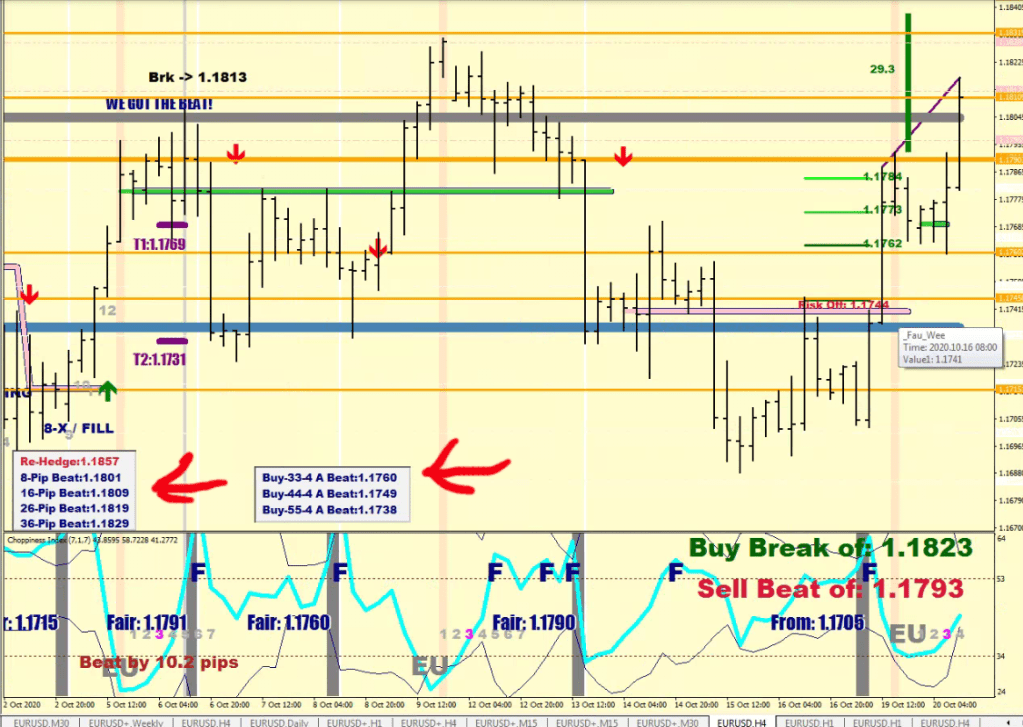
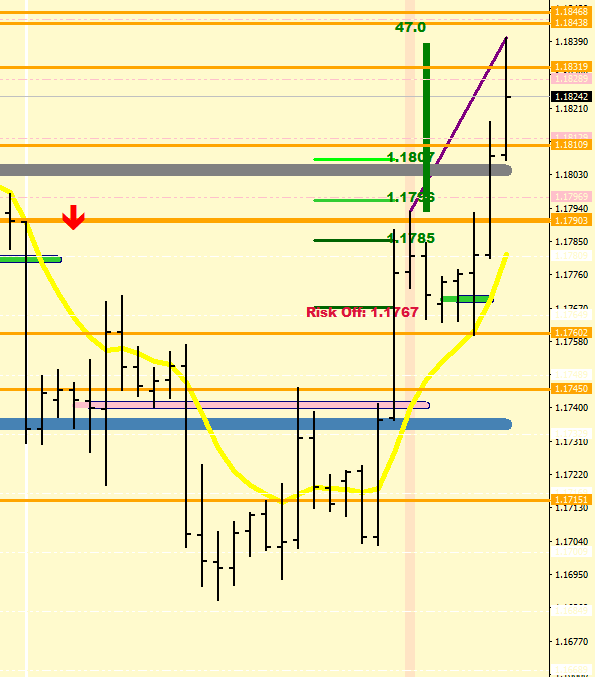
1.1750 was missed by 2 pips – but put the break out hedge 1 pip further still to avoid trigger happy MMs.