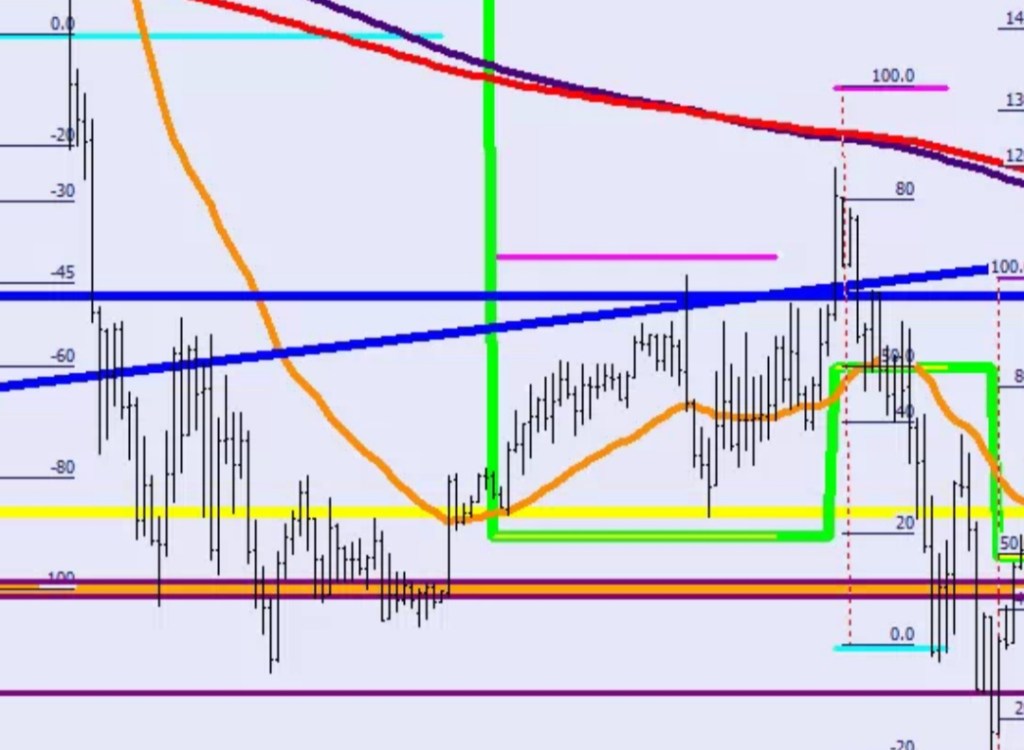
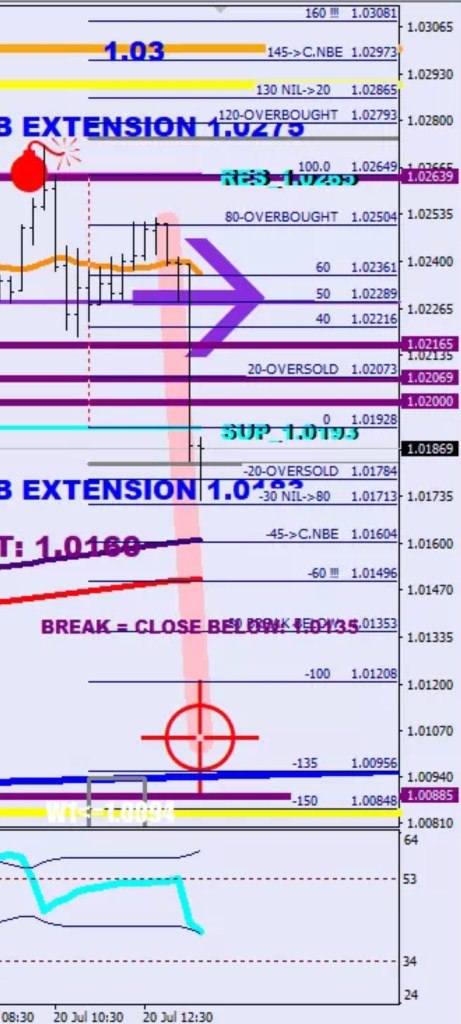
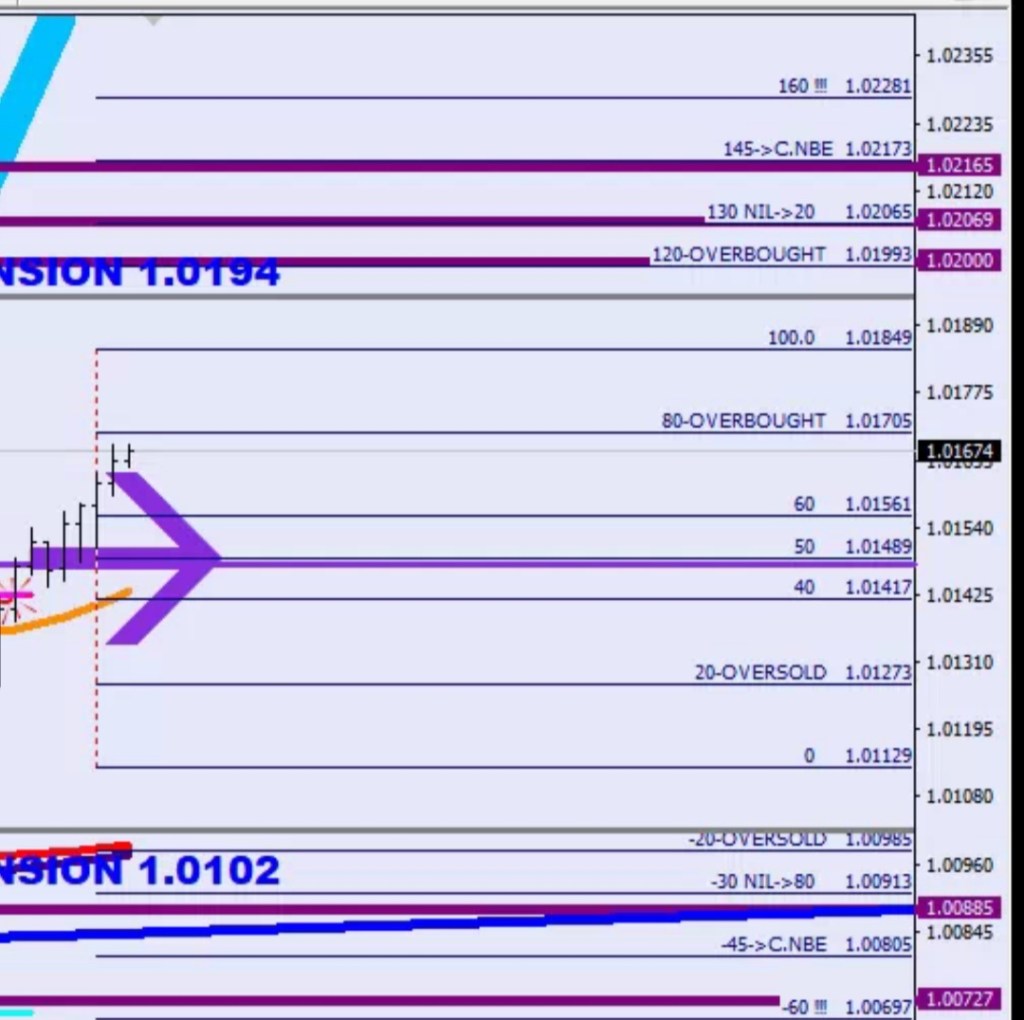
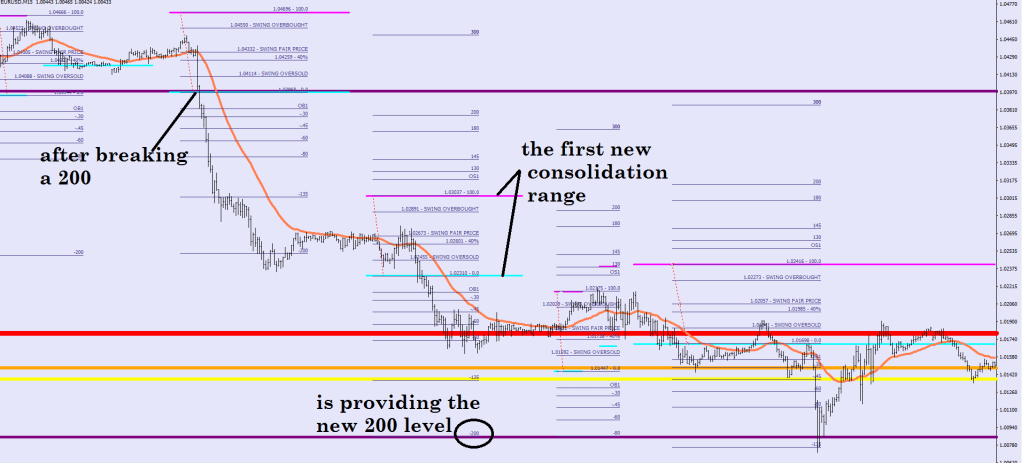
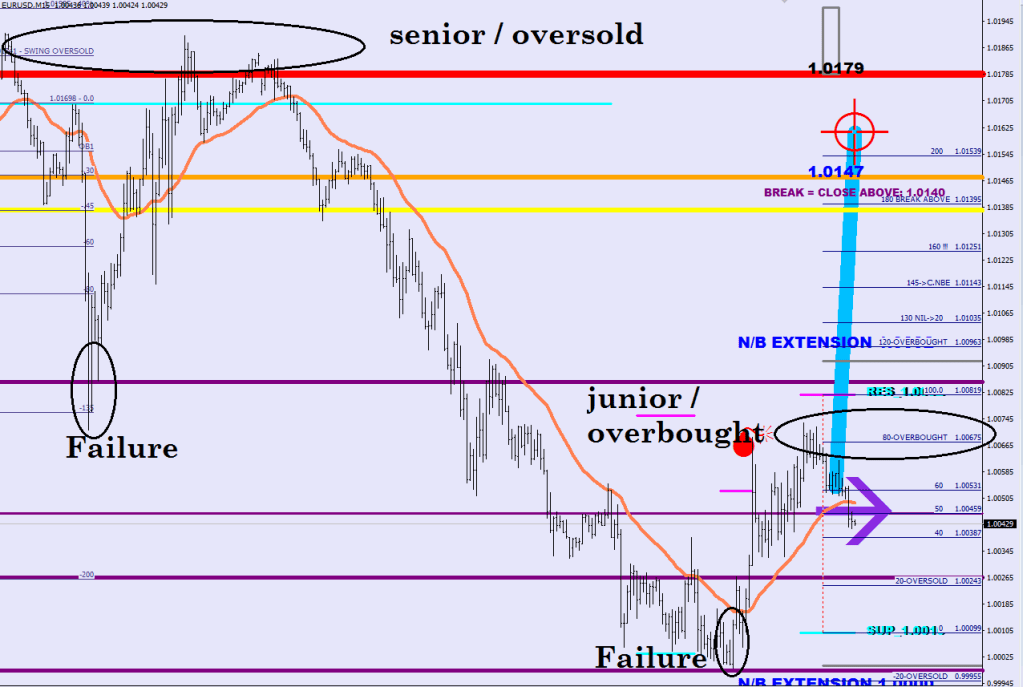
An example of a 100/200 failure above. 100 meaning an extra Range distance down, the 200s are automatically plotted 2x Range distances made by previous ranges (within the sample).
Price comes back to the Overbought level of the range that gets drawn in the future.
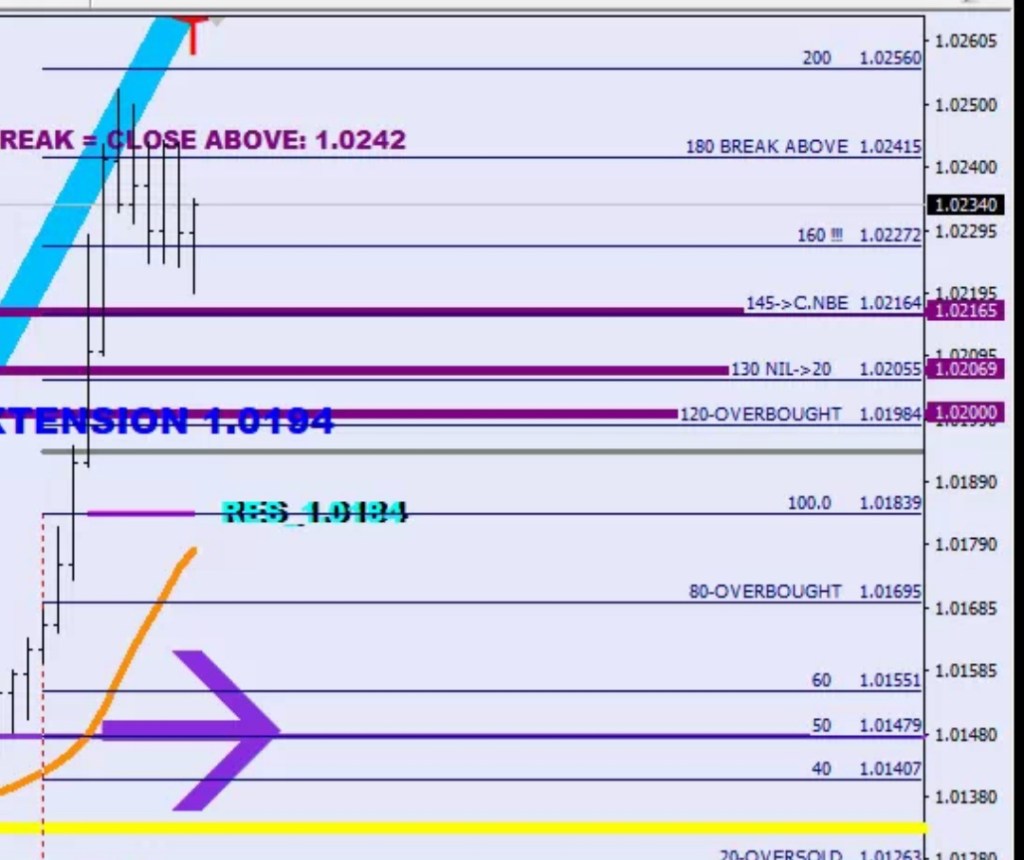
Another example of a 100/200 failure from a couple of days ago. Not quite as clean, but ultimately did the same thing – failed back to a future overbought level (of the 2nd consolidation range). Look for the -100 on the bottom left and the 80 up on the right.
The fun part is that a failure does not change the market ditection, but bucks the trend as long as the lasso can reach.
Now, what about this Malcolm in the Middle?
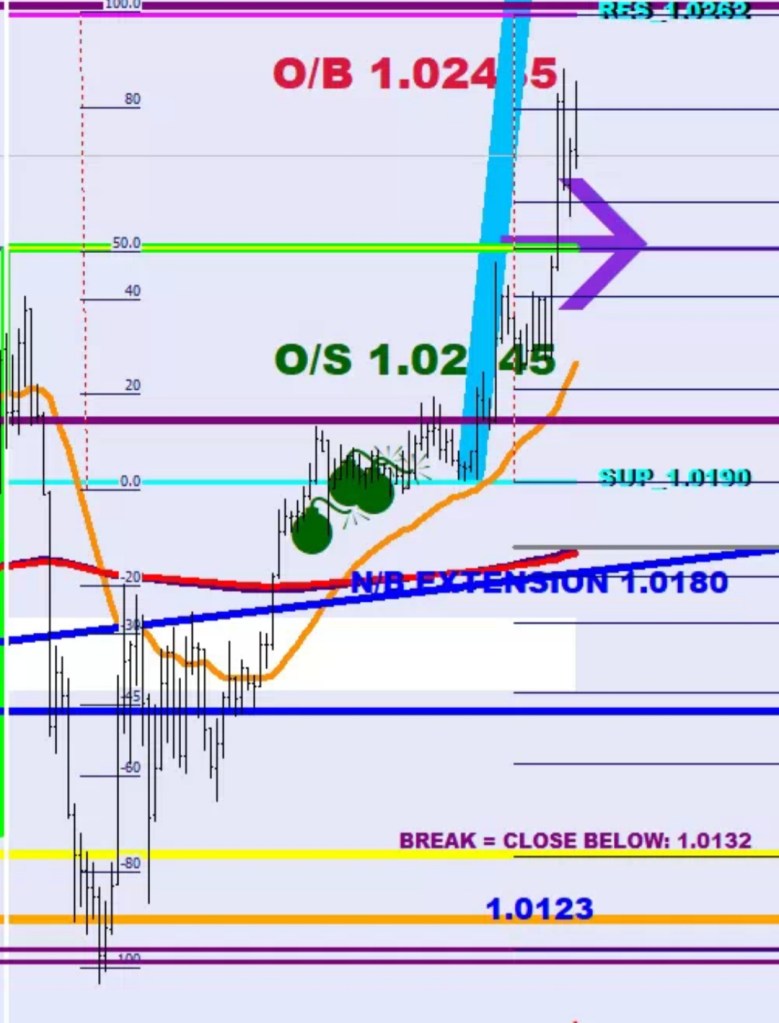
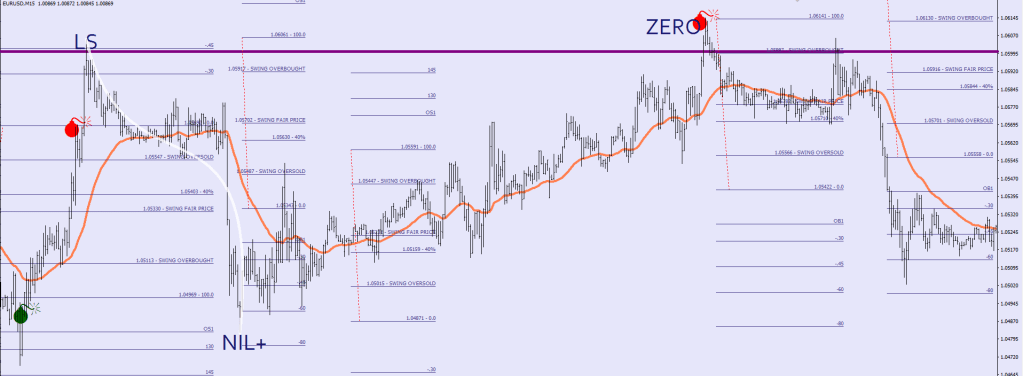
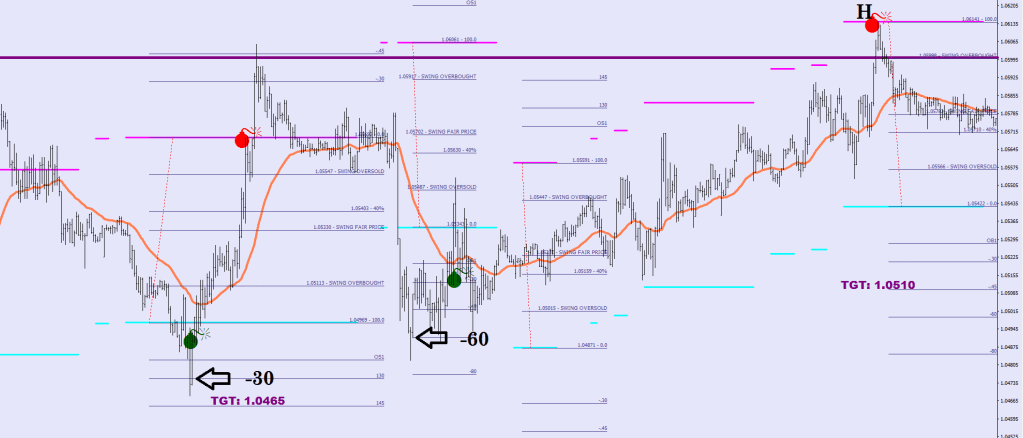
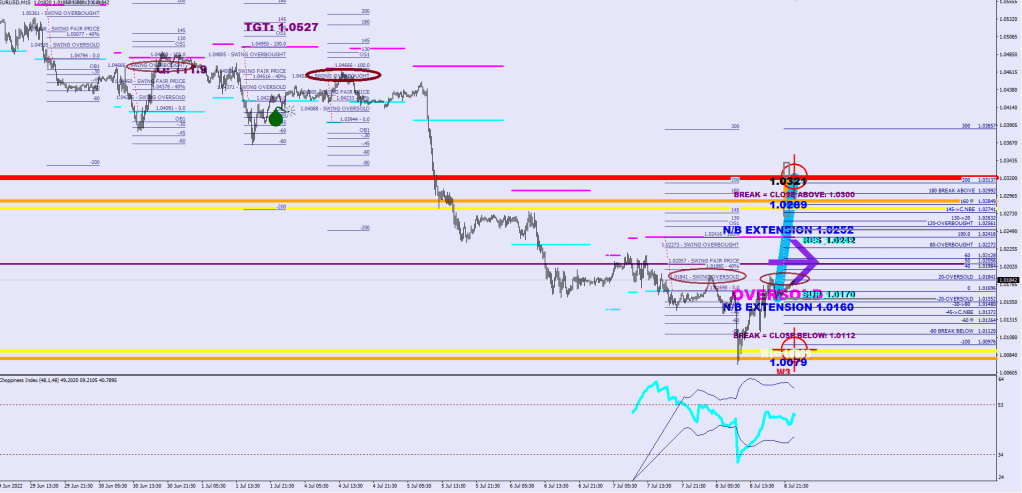
This was a liquidity grab, look at the sequence at the bottom: there was a Zero print followed by a buy at the future oversold level. It resulted in an ABC move printing 180 (overbought of the extension Range) on A and 180 on C.
On the chart you see a lower low being made, but relative to the Range, this second leg fell shy by 20%. An impulse bottom.
Where was a Left Shoulder/Butt Cheek at all? I could not see one.
If you want this to be a bottom and an IHS, that would come handy. You want bottoms to be spankable. You want the power of love to be overwhelming.
I don’t usually engage in blog articles that are rubbing in, but I do like to show you the world and what else is out there.
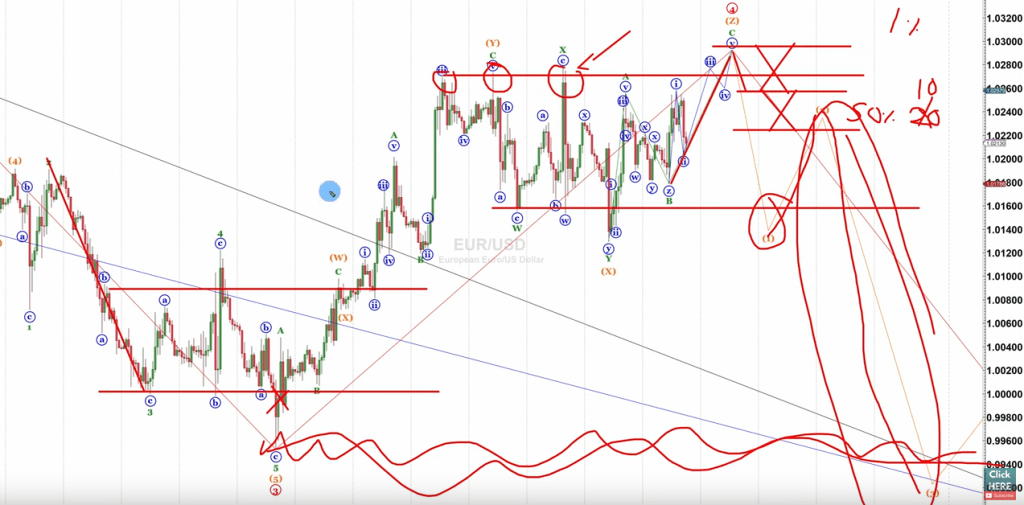
So I do appreciate that everyone is trying their butt off to be making coherent moves in the market. It is ridiculously hard. No matter how intelligent you are, if you are not understanding the true mechanics, then your conclusions would not be right either.
In short, this Elliott Beethoven decided that there would be a higher high, he would go short 20 lots, cover 10 lots at twice the length of his risk (1 to 1), then cover 5 more lots at the lower horizontal line and ride 5 more lots for a home-run to below the last low and beyond. At least this is what he said in his recruitment video for future paying members.
-200 is at 1.00447
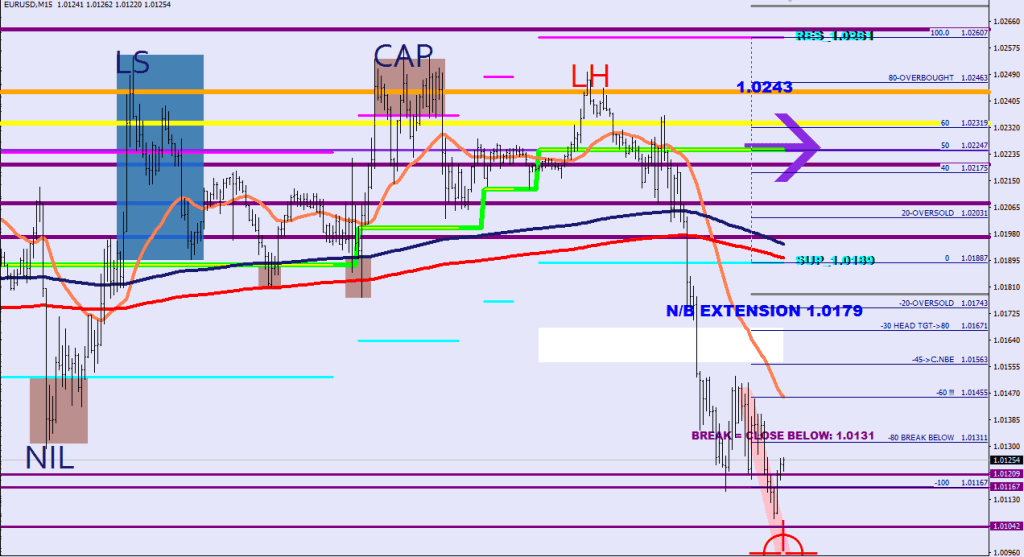
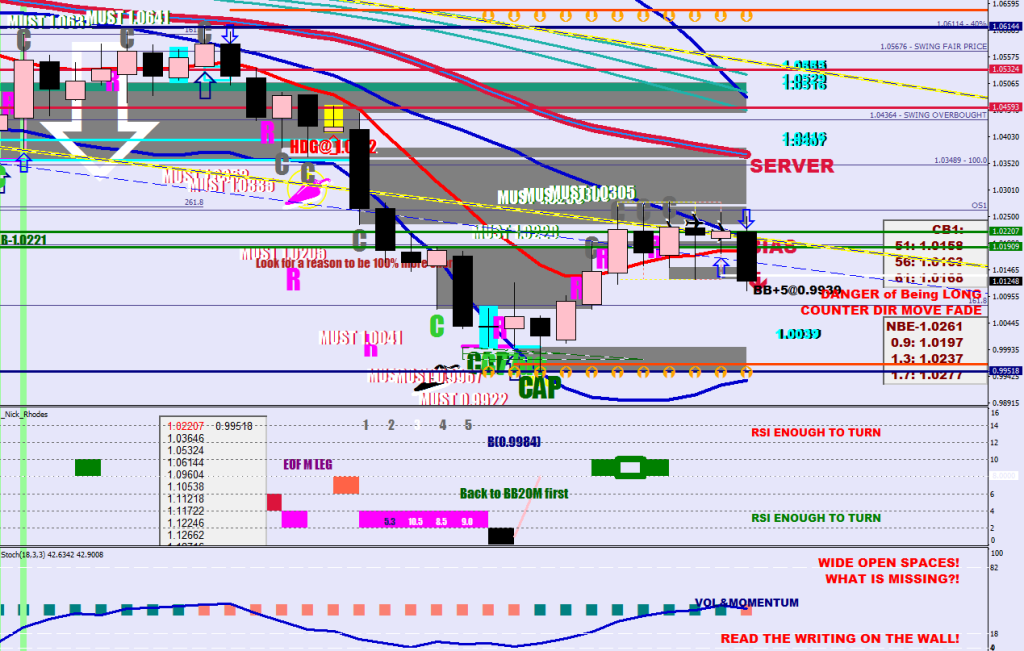
I, on the other hand have identified the Left Shoulder, the CAP (a bit more complex than a head) and the Lower High when price returned to the overbought level for a Kiss Goodbye. I was not looking for a higher high, so I ended up participating instead of watching from the sidelines.
Thanks to my understanding of the range, I would be looking for a Left Shoulder, then a Head/Cap and the KGB to fully reverse my position. I also understand that price has to first paint a new range, as it went beyond the point of no return.
Enthusiasm is one thing, intelligence is another, but knowing the right answers is like playing in a different league entirely.
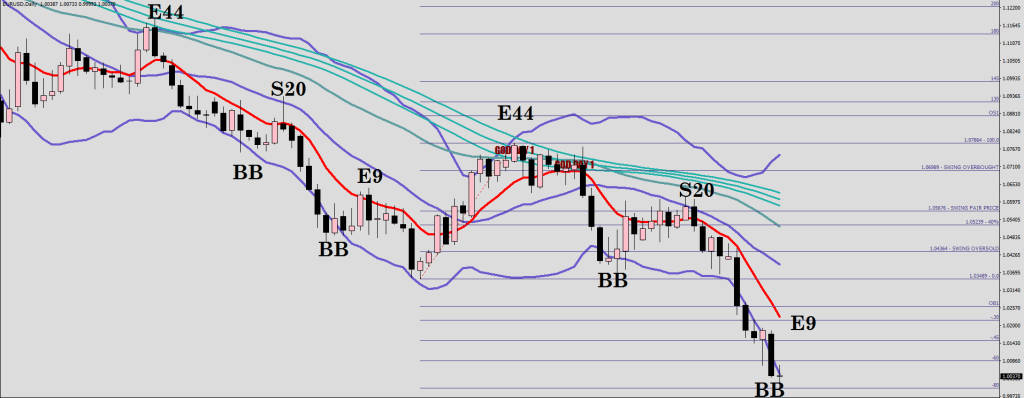
Just like earlier, when the first 8 days failed to to touch the E-44, the momentum flipped negative on day 9 by default.
Quoting Ira Epstein, “why would you do anything before the reports come out?” – “I think they are going to be fighting a battle right here for the next 3 days.”
Except, the 9th day had arrived. Intention is one thing, experience is another. Learn to trade with the range.
Lasr entry of the series about comfirmations & story line.
License to Ill
The confitmation to the LS is a return to the 50% line of the range (from now on in green).
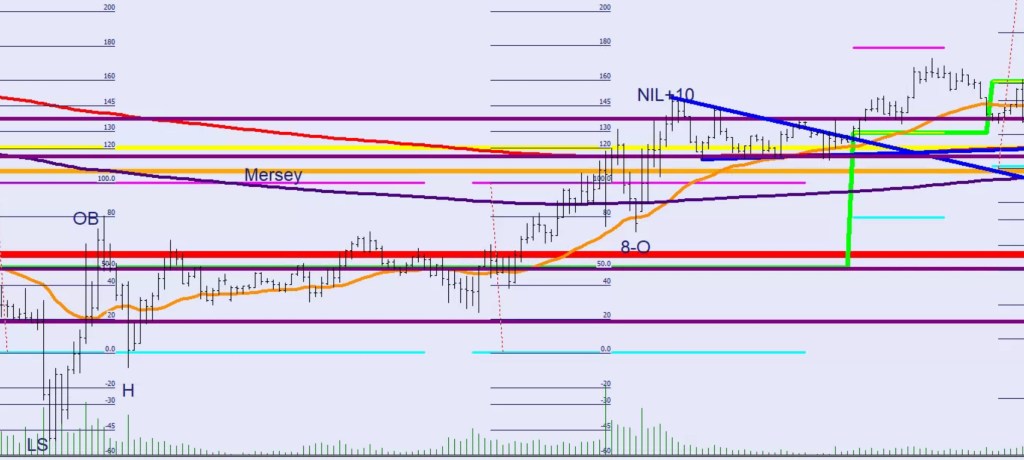
Ferry have no Mersey
The confirmation of the head in place (new direction on) is an hourly close on the other side of the 89-121 band.
I’m at work currently, will add pictures later.
So what is the game here played then?
A continuum. There are positive and negative syne waves. The hourly E-89 to E-121 is the bridge that cannot be crossed without a license. The buerocracy dictates that there would be two steps to attain the stamp for crossing. A left shoulder is the petitioning office. They accept the case by letting price return to the consolifation mean. Their open hours are from 45% to 70% outside the current range.
The stamp duty is paid to the Head. This is a Zero line that raises the water level temporarily to ideal for the ferry to cross (& then ypu can go out with the high tide ~ pull back to oversold). A draw bridge made out of water. Oh, mercy, mercy me.
C’mon, gimme props for making 7 blog entries about NILs without mentioning Holgerson anywhere.
Here’s an example on how to apply this knowledge in practice about the Mersey the LS and the H.
There was a long trade to be had from the Band to the Zero level. There was a short trade to be had from the zero level.
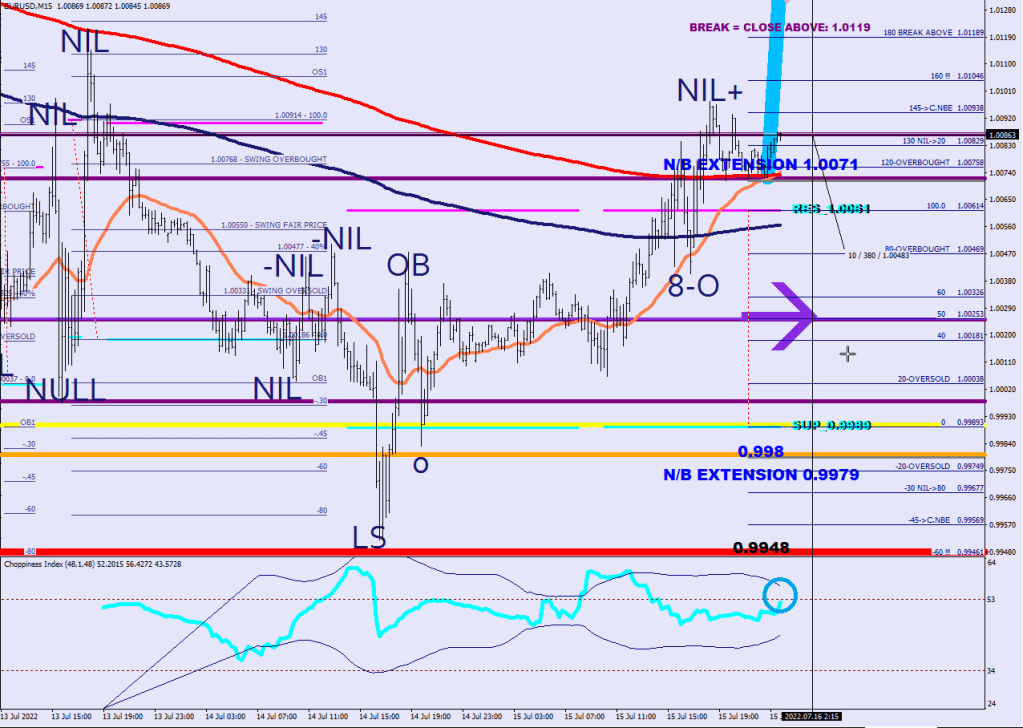
Now, what to make of this move from -35 back to 135? It was certainly unexpected. All I can think of is if I was tasked with plunge protection, I would be buying below the E121H (Red line).
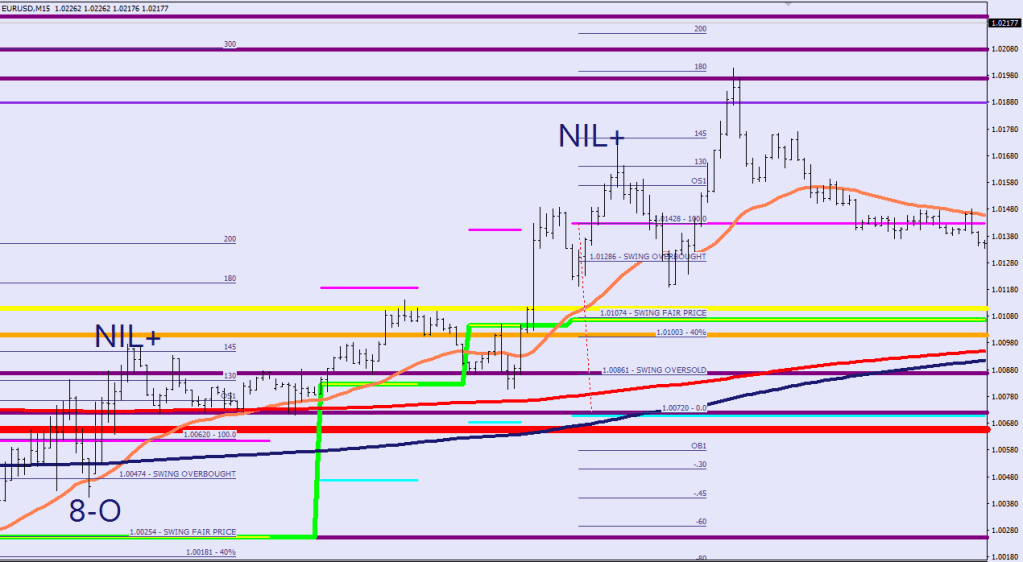
Here are 2 examples for a NIL+ not becoming an LS (no tie back to the fair price).
A left shoulder is a NIL+ against a prevailing direction effectively choking it / matching it. Obviously the first move coming off a head print would not likely qualify for an LS.
I have cited point of no return a number of times in my columns.
Relative to the consolidation range, I put the NIL+ range from an extra 45% to 65%. Something going beyond 80% will have exceeded the point of no return.
About the NIL+ to -NIL wrapping. The wrapping takes place around the current Zero level (this can be a 0-Cyan or a 100-Magenta) as this level becomes the anchoring axis of the mini pendulum swing(s). -NIL is meant to say “mirror” swing, and it happens towards the inner side of the range.
Whichever current NIL level gets exceeded by 10+ pips would be marking a breakout underway.
I know that OBGYN and fish can co-exist consentually.
Subtle things.
Napoleon Dynamite reminds us that the can’t get leg that tagged the daily 20 SMA, would be good for a head if only we could trade in the multiple fails at 300 for an LS. Also, if we could credit a move down to 30 with going oversold during low volatility, this tagging of the overbought level would be the perfect short entry.
There was a break above the NIL+ by 10+ pips. Next target could had been the 300 level at 1.02069, but we had a failure at 1.0199 which was a 300 level of a previous range and the subsequent reaction went to the overbought level of the senior range.
I wasn’t certain if the first pull back to the zero after the LS print counted as a head, for there was no new consolidation / range adjustment.
Now I know that it was true love.
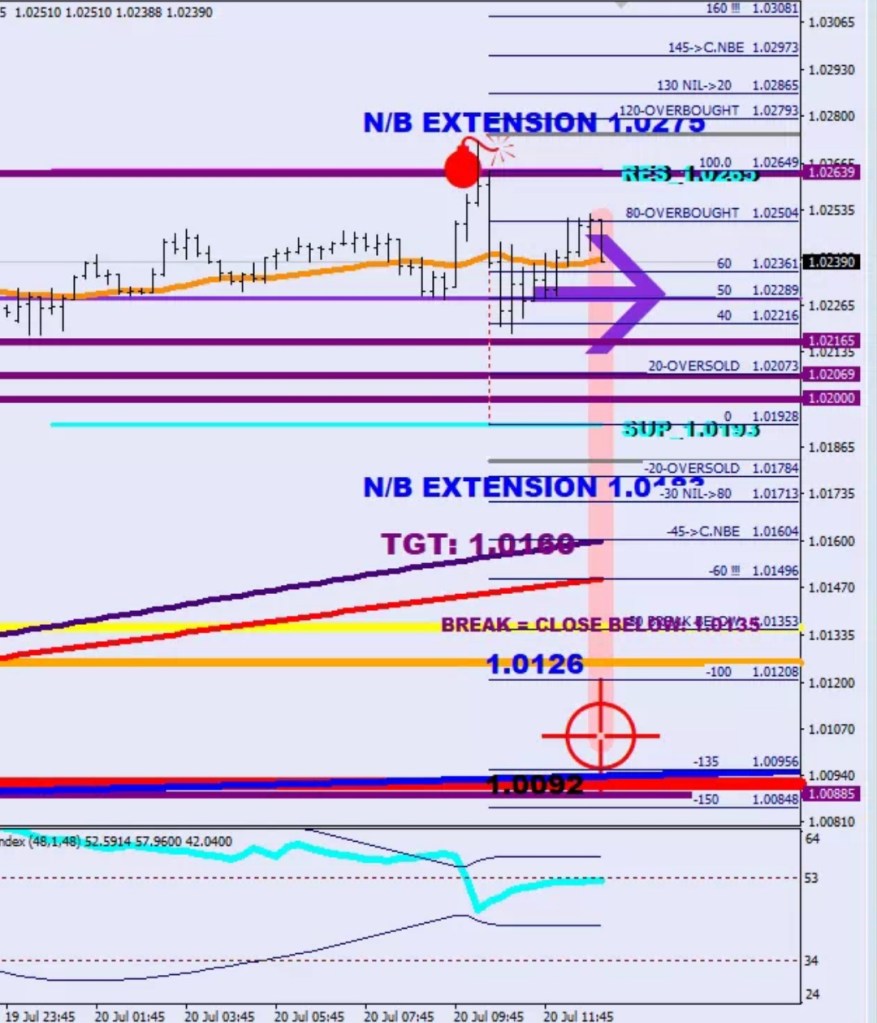
We are looking for a left shoulder again then.
45% is at 1.0217. 60% at 1.0228
After the left shoulder price would have to go oversold (1.0126), consolidate thrn tag a fresh Zero (100 / top of the range).
Remember, the full reversal is a 2-step process.
Rather strong move for an LS.Another day, another LEMA.
Let’s assume that changing the market direction is a two step process.
It requires a qualified left shoulder and subsequently a head print.
I’m saying this to make you understand that although the move coming off of a left shoulder may swing out in the opposite direction as much as the left shoulder did, it does not change the status of the market and is not considered as another left shoulder now in the other direction.
In this example there were 5 days between the LS and the H.
The rebound form the left shoulder I call NIL+, for it goes beyond 30%. In fact what I mean is at least by one step which puts price at 45%, perhaps somewhere even at 60-70%.
I do this as a reminder for the distance as well highlighting the outermost reading as a not to be violated by 7+ pips stop level.
Although the left shoulder would eventually print, it should not be anticipated, only recognized. Instead when price blows through the last relevant NIL print by 10 pips your aim should be a failure at the next 200 level. I would look for the turn to take place 15 pips beyond the 200 line.
Our current example of the LS to NIL+ looks like this.
Once the NIL+ is set, the contraction in volatility should make price stay away.
Sure, this one is a bit different, as price seems to be well on the way to a mean reversion. It all comes down to the weekly open. I showed you before how much the bears were hammering price down at this viaduct.
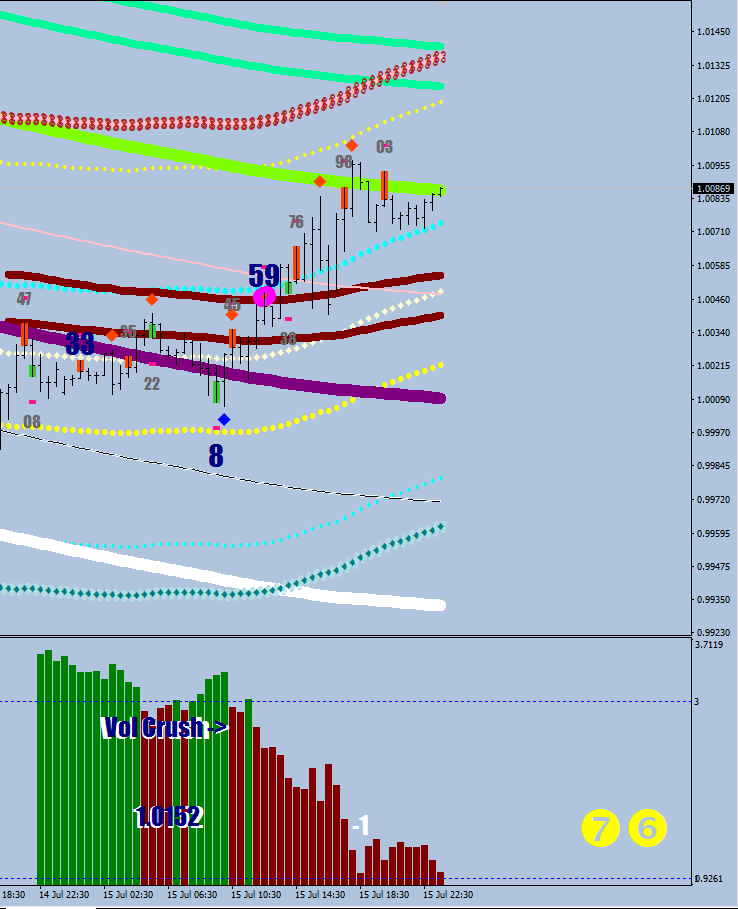
The Green River is the 9-day EMA (high to low). Price is trying at the lower Guard Rail for the 3rd time.
To me the logical move would be a pull back to a head – and a new range is about to be defined.
If price was to open flat, a 36+ pips move would put the new zero level about where the last overbought print was at.
-NIL is a counter-wrap around the nearer Zero Level. The EMAs are 366 (approx E89 hourly) and 484 (E-121 hourly).
So an LS makes the market go neutral (& starts a full swing move on the pendulum), a head adds on the new direction. The Zero level to be hit is crucial, you have like 7 pips of tolerance beyond. Again, the head should not be anticipated, but once in place, the next oversold level is the perfect entry.
The only other example of the LS + H combo was an LS – OB – Fresh Zero (unlike currently) and from all heads you should see a move to the 200 (on the upside 300) line printed by the very same range, but speed may vary.
It took forever to get the capsize right with optimal stochastic to get a change of momentum.
World Full Of Nothing.
A NIL appears in a no trend / weak trend phase. Fade up to 2 NILs in a row, but a senior zero may be used as a jumping board. NIL to NULL
A NIL is an intention of proceeding in a direction (trying, but not immediately succeeding – i.e. hitting nothing = NihIL). The NULL (as measured by the previous range) is the counter move. A NULL is the zero level of the previous consolidation range (look left). When the sequence of NIL->-20OS gets taken out, look for the left shoulder forming.
The Head would be a Zero of a fresh range, after which an Overbought to Oversold move would be the optimal buy entry.
If a NIL faces aggression at the nearby, senior range OB/OS level that’s a sign of intention to expand the current total range by 100. Maximum aggression is the closer NULL.
For once there are a lot of videos on the subject.
Junior Range bear run short entry 80- 1.10 Senior Range (8hrs+) bear run short entry 0-30 Target -200 failure
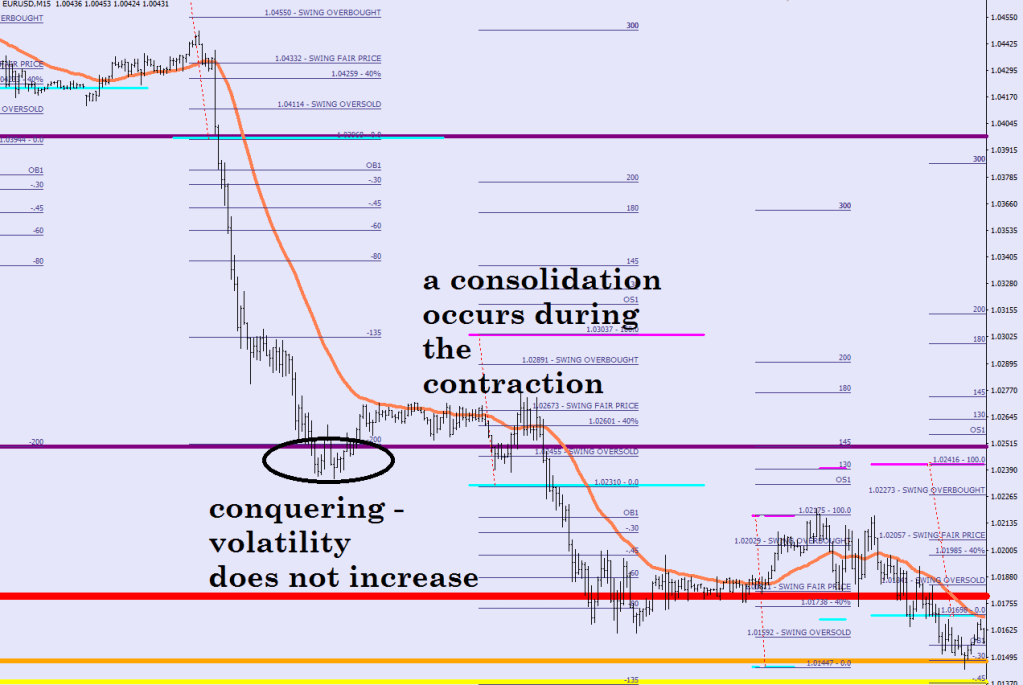
A failure means not closing on the other side of the line for more than a full hour & volatility increasing
A conquering is 5+hours closing on the other side of the line and volatility is on the decline (contraction)
A failure bounces back to the last OB/OS level. A failure is not a reversal, but it warrants attention in case they buy the next, newly printing opposite zero.
An example of failing a 200 (back to afore mentioned time sorted sell levels).
A failure does not change the overall direction, it is a mere bounce.
Another example of conquering
An example for why using the range is better than Fifonacci or Farket Frofile.
During the last bull run in the bear even the bulls were the bears. After every leg up they covered 20-30 percent later.
Understand me.Trying to Capsize hard, but stoch is still a tad higher than it would be desired to flip the momentum. Perhaps a close a little lower…The sequence
You can try it at home, but do not bother with IC Markets, for they would suspend your account using the bandwidth for placing and deleting pending orders (hyperactivity they call it).
// Hedge 50 pips out for 1-position by Macdulio (forexfore.blog) in 2022

#include <stdlib.mqh>
extern int magic_number = 60;
extern int magic_number2 = 61;
int profits;
double Lots;
  double nakedshorts[];
  double nakedlongs[];

  double open_price;
  double stop_loss_price;
  double take_profit_price;
  double open_price2;
  double stop_loss_price2;
  double take_profit_price2;

   double OrderOpenPrice;
 double OrderProfit;
 double orderstoploss = OrderStopLoss();
  string symbol = Symbol();

int init() {
   return(0);
}

int deinit() {
  return(0);
}

int start() {
  double longaveragebuffer;
double shortaveragebuffer;
int order_type;

int i, counter;
int counted_bars=IndicatorCounted();
int longcount = 0;
int shortcount = 0;
double nlongs =0;
double nshorts= 0;
double shortopenedat;
double longopenedat;
double longsize;
double shortsize;

profits = 0;
 int hstTotal=OrdersHistoryTotal();

 counter = 0;
int overdrivecounter =0;


 for(i=OrdersTotal()-1; i>=0 ; i--)
 {

   if(OrderSelect(i,SELECT_BY_POS,MODE_TRADES)==false)
        {
           Print("Access to orders list failed with error (",GetLastError(),")");
           break;
        }
             if (OrderType() == OP_BUY && OrderMagicNumber()!=magic_number)
             {
               nlongs = nlongs+OrderLots();
               longcount = longcount+1;
               longaveragebuffer = longaveragebuffer+(OrderOpenPrice()*OrderLots());
               longopenedat = NormalizeDouble(OrderOpenPrice(),5);
               longsize = NormalizeDouble(OrderLots(),2);
             }

             if (OrderType() == OP_SELL && OrderMagicNumber()!=magic_number2 )
             {
               nshorts = nshorts+OrderLots();
               shortcount = shortcount+1;
               shortaveragebuffer = shortaveragebuffer+(OrderOpenPrice()*OrderLots());
               shortopenedat = NormalizeDouble(OrderOpenPrice(),5);
               shortsize = NormalizeDouble(OrderLots(),2);
             }

   }

if (shortsize!=0) Print ("shortsize:",shortsize);
if (longsize!=0) Print ("longsize:",longsize);


double  account = AccountEquity();
//double MaxLots = NormalizeDouble(AccountEquity()*.00265,2);
double MaxLots = NormalizeDouble(AccountEquity()/2/1000,2);

   double longsz;
   if (nshorts==0 && Close[0])  longsz=NormalizeDouble((MaxLots-nlongs),2);
   else longsz = NormalizeDouble((nshorts-nlongs),2);
   if (longsz>MarketInfo(symbol,MODE_MAXLOT)) longsz=MarketInfo(symbol,MODE_MAXLOT);


  if (nlongs-nshorts<=0 && shortsize>0 && shortopenedat+500*Point>Ask)
  {
   open_price = NormalizeDouble(shortopenedat+500*Point, 5);
    stop_loss_price = NormalizeDouble(0.0,Digits);
    take_profit_price = NormalizeDouble(0,Digits);
 for (i = OrdersTotal() - 1; i >= 0; i--)

      if (OrderSelect(i, SELECT_BY_POS))
        if (OrderMagicNumber() == magic_number) {
          order_type = OrderType();
          if (order_type == ORDER_TYPE_BUY_STOP) {
            if ((NormalizeDouble(OrderOpenPrice(), Digits) != open_price) || (NormalizeDouble(OrderStopLoss(), Digits) != stop_loss_price) || (NormalizeDouble(OrderTakeProfit(), Digits) != take_profit_price)) {
              if (!OrderModify(OrderTicket(), open_price, stop_loss_price, take_profit_price, OrderExpiration()))
                Print("Error: ", ErrorDescription(_LastError));
            }
            break;
          }
          else if (order_type == ORDER_TYPE_BUY)
            break;
        }
    if (i < 0)
      if (OrderSend(symbol, OP_BUYSTOP,  shortsize, open_price, 3, stop_loss_price, take_profit_price, magic_number+" Hedge Break Of - BUY", magic_number,0) < 0)
        Print("Error: ", ErrorDescription(_LastError));
  }


   double shortsz;

  if (nlongs==0) shortsz = NormalizeDouble((MaxLots-nshorts),2);
  else shortsz = NormalizeDouble((nlongs-nshorts),2);
  if (shortsz>MarketInfo(symbol,MODE_MAXLOT)) shortsz=MarketInfo(symbol,MODE_MAXLOT);


 if (nshorts-nlongs<=0 && longsize>0 && longopenedat-500*Point<Bid)
   {

   open_price2 = NormalizeDouble(longopenedat-500*Point, 5);
    stop_loss_price2 = NormalizeDouble(0,Digits);
    take_profit_price2 = NormalizeDouble(0,Digits);
    for (i = OrdersTotal() - 1; i >= 0; i--)
      if (OrderSelect(i, SELECT_BY_POS))
        if (OrderMagicNumber() == magic_number2) {
          order_type = OrderType();
          if (order_type == ORDER_TYPE_SELL_STOP) {
            if ((NormalizeDouble(OrderOpenPrice(), Digits) != open_price2) || (NormalizeDouble(OrderStopLoss(), Digits) != stop_loss_price2) || (NormalizeDouble(OrderTakeProfit(), Digits) != take_profit_price2)) {
              if (!OrderModify(OrderTicket(), open_price2, stop_loss_price2, take_profit_price2, OrderExpiration()))
                Print("Error: ", ErrorDescription(_LastError));
            }
            break;
          }
          else if (order_type == ORDER_TYPE_SELL)
            break;
        }
    if (i < 0)
      if (OrderSend(symbol, OP_SELLSTOP, longsize, open_price2, 3, stop_loss_price2, take_profit_price2, magic_number2+" Hedge Break Of - SELL", magic_number2,0) < 0)
        Print("Error: ", ErrorDescription(_LastError));
  }


  return(0);
}
This is one free piece of the puzzle. The 50 pip was designed for an accurate entry, an oversold / overbought neckline relative to the current consolidation mean. In theory it should never get a fill if you can figure the direction right (where was the last qualifying head & shoulder) and if you don’t get unlucky overnight with an extra 10 pips in both direction on the bid and the ask from your broker.
I wrote the program blind (offline, over the weekend), if it does not function well, come back I’ll update it.
It was designed for one single entry, yes. What does the routine do if you open a second position? Leave it in the comments.
CI has not recharged yet for a new center to be in place.
The thinking is of course simplifying things. One single position, that is the max size that a 50-pip move against would not result in a 50% draw down. The management of the hedge is based on understanding where to exit it and capturing back some / all of that temporary loss during a counter move. Protective stop loss once in the clear is a good idea. Gotta learn when to have the automated trading button temporarily off.
Guy’s a genius.
Ok, Madis is Bringin’ it too.
Now, let’s talk about that close again. It settled on a Green C, because the stochastic went higher than the target range (buying got too eager). You could still see a green period after this with a Green Laser Beam on Monday or simply a float sideways to up, but I would surrender all upside hopes upon tagging the E-9 (Red).
















 ForexFore - Internals, indicators, algorithmic trading